
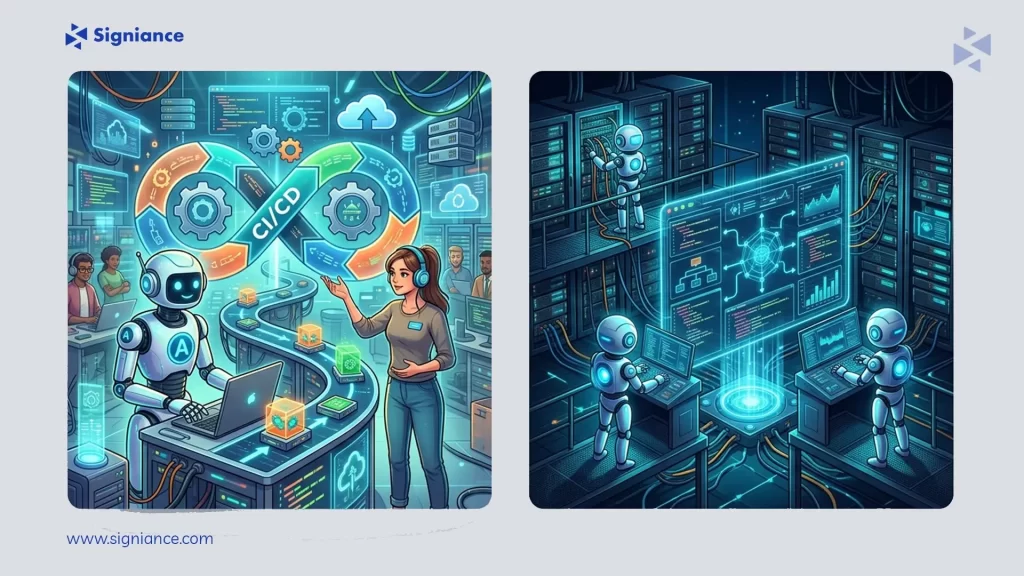
DevOps has always been about reducing friction.
From manual deployments to CI/CD pipelines, and then to infrastructure as code, every step has aimed to remove repetitive work and speed up delivery.
Yet, even with all this progress, most DevOps teams still spend a significant amount of time dealing with issues that are far from automated.
Pipelines fail.
Alerts pile up.
Logs need to be analysed manually. And decisions still depend heavily on human intervention.
Now, agentic AI is entering this space with a different promise.
Not just to automate tasks, but to observe systems, understand context, and take actions.
The idea sounds compelling.
But for many engineers, the question is simple:
Does this actually make things easier, or just add another layer of complexity?
The Problem: DevOps Is Automated, But Not Autonomous
Modern DevOps environments are filled with tools.
CI/CD platforms, monitoring systems, logging tools, infrastructure management, security checks, everything is automated to some extent.
But automation has limits.
Most systems today follow predefined rules:
- If a build fails → notify the team
- If CPU usage spikes → trigger scaling
- If deployment fails → rollback
These rules work, but they lack context.
When something unexpected happens, the system stops, and engineers step in.
This leads to familiar challenges:
- Alert fatigue with too many signals and not enough clarity
- Time spent debugging pipelines instead of improving them
- Context switching across multiple tools
- Delayed incident resolution
- Manual decision-making under pressure
In short, DevOps is automated, but still heavily dependent on human reaction.
What Changes with Agentic AI
Agentic AI introduces a different approach.
Instead of only executing predefined instructions, these systems can:
- Observe system behavior across logs, metrics, and pipelines
- Analyze patterns and identify possible causes
- Suggest or take actions based on context
This is not about replacing pipelines.
It’s about adding a layer that can reason and act within them.
For example:
Instead of just alerting that a deployment failed,
an agentic system could:
- Check recent changes
- Analyze logs
- Identify a likely root cause
- Suggest a fix or trigger a rollback
The shift here is subtle but important.
From:
“Run this when X happens”
To:
“Understand what’s happening, then decide what to do”
Where Agentic AI Fits in DevOps Workflows
1. CI/CD Pipelines
Build failures are common, but debugging them is time-consuming.
Agentic systems can:
- Analyze build logs
- Identify common failure patterns
- Suggest fixes or re-run steps intelligently
This reduces the time engineers spend chasing errors.
2. Monitoring and Observability
Traditional monitoring tools generate alerts.
They rarely explain them.
Agentic AI can correlate:
- Metrics
- Logs
- System events
And provide a clearer picture of what actually went wrong.
3. Incident Response
During incidents, speed matters.
Agentic systems can:
- Trigger predefined runbooks
- Execute remediation steps
- Assist in identifying root causes
Instead of waiting for manual intervention, the system becomes part of the response.
4. Infrastructure Management
Scaling decisions are often rule-based.
Agentic AI can improve this by:
- Understanding usage patterns
- Adjusting resources dynamically
- Optimizing for both performance and cost
The Tools Driving This Shift
Several tools are already moving in this direction, each focusing on different parts of the DevOps lifecycle.
OpenClaw AI is gaining attention for its ability to interact with systems and execute workflows rather than just respond to prompts.
GitHub Copilot is expanding beyond code suggestions to assist with workflow-level tasks, including CI/CD configurations.
AWS Bedrock Agents and CodeWhisperer are enabling teams to build systems that can interact with infrastructure and automate decision-making at scale.
PagerDuty AI focuses on incident intelligence, helping teams respond faster with better context.
Harness AI brings intelligence into CI/CD pipelines, helping optimize builds and reduce failure rates.
These tools are not identical, but they share a common direction:
Moving from automation → assisted decision-making → partial autonomy
Where the Complexity Still Exists
Despite the potential, agentic AI is not a perfect solution.
There are real challenges:
- Integrating with existing DevOps stacks is not always straightforward
- Systems still require clear boundaries and permissions
- Over-reliance can introduce risks if actions are not properly controlled
- Engineers need to understand how decisions are being made
In many cases, agentic AI does not remove complexity.
It shifts it.
From writing scripts → to designing intelligent systems.
Conclusion
Agentic AI is not a magic fix for DevOps.
It does not eliminate the need for engineers, nor does it instantly simplify complex systems. What it does offer is a shift in how work gets done.
Instead of reacting to systems, teams can start building systems that assist in decision-making and execution. For DevOps engineers, this means moving further away from manual intervention and closer to designing systems that can operate with context.
So, does agentic AI help?
Yes, when it is applied thoughtfully and integrated into real workflows. Otherwise, it risks becoming just another tool in an already crowded stack.