
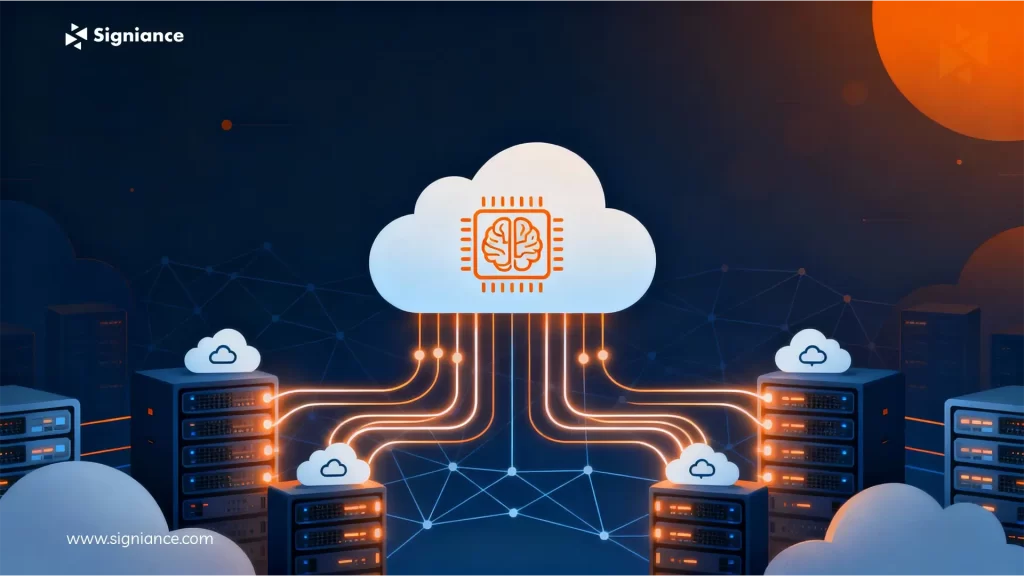
Inside Amazon’s Vision for Smarter, Scalable AI Systems
Artificial intelligence has moved far beyond the experimental phase. Businesses of all sizes , startups, enterprises, public sector teams , are actively turning AI into part of their daily workflows. But behind every AI capability there is serious infrastructure, orchestration, and engineering. And that’s exactly what AWS is focusing on.
In a recent AWS official session (video link below), the team broke down how Amazon is approaching the next generation of AI systems , not just as tools, but as a complete platform that helps organizations build, scale, customize, and operationalize AI in production. This blog is a deeper, more conversational breakdown of those key takeaways.
AWS Official Video Reference:
https://youtu.be/GizM302bYKw?si=TwUO7N2AI_jTdBjx
(All credit for the technical insights goes to AWS and the original presenters.)
AI Needs More Than a Model , It Needs an Ecosystem
One of the strongest points made in the AWS session is that AI doesn’t start or end with a model. Models are simply one piece of the full equation. For businesses, the real challenge lies in building everything around the model:
- Infrastructure that can scale
- Data pipelines
- Security and governance
- Monitoring and evaluation
- Reliable deployment frameworks
- Customization workflows
- Cost-efficient training and inference
AWS positions itself not as a model provider, but as the platform that helps you bring all these pieces together.
Why Model Customization Is the Future , Not Just Pretrained Models
Across industries, companies are beginning to realize that generic models rarely fit their needs. Every business has its own terminology, workflows, compliance boundaries, product data, customer behavior, and domain language.
AWS emphasizes that this is where model customization becomes essential. Instead of relying on out-of-the-box models, AWS encourages organizations to tailor models using their own data. With services like Amazon SageMaker, teams can fine-tune models to:
- Understand product-specific queries
- Produce domain-relevant answers
- Automate decisions without hallucinations
- Reduce errors in real operational settings
Customization isn’t just “nice to have” , it’s what makes AI usable in real workloads instead of generic demos.
The Shift Toward AI-Driven Workflows
AWS also makes it clear that AI is no longer something that sits at the edge of a project. It’s becoming embedded into every workflow , whether it’s customer support, security operations, supply chain planning, legal document processing, or software engineering.
This shift means companies need tools that work smoothly with existing systems. AWS demonstrates how services like:
- Amazon Bedrock
- SageMaker
- Lambda
- Step Functions
- RDS / DynamoDB / S3
can be orchestrated together to power AI pipelines.
In simpler terms: AI isn’t a separate project anymore , it’s becoming part of the operational backbone.
The Importance of Secure, Governed, and Responsible AI
A recurring message from AWS is that AI cannot move fast unless it is safe, reliable, and controlled.
Security, governance, and evaluation are not optional layers. They’re mandatory if businesses want AI systems to work long-term without unexpected failure or risks.
AWS highlighted:
- Guardrails
- Model evaluation tools
- Data boundary controls
- Access management
- Encryption
- Responsible output testing
- Continuous monitoring
These guardrails help businesses adopt AI without losing control or exposing sensitive data , which is one of the biggest blockers to enterprise adoption.
Building AI at Scale Requires Strong Engineering Foundations
AWS reminds us that AI doesn’t become “enterprise-ready” without strong engineering practices. Many organizations try AI experiments but get stuck when they attempt to scale.
Why? Because scaling AI requires:
- Distributed training
- High-performance compute (GPU/Accelerators)
- Efficient inference
- Cost control
- Observability
- Automated deployment
- Versioning and rollback strategies
AWS is heavily investing in solutions that reduce the operational burden of scaling AI , allowing teams to focus more on value and less on infrastructure hurdles.
AWS’s Message Is Clear: AI Must Be Practical, Not Just Impressive
What stands out across the whole session is Amazon’s philosophy: AI is only useful if it is reliable, integrated, customized, and operationally manageable. This is a refreshingly grounded take during a time when the industry often chases hype.
AWS focuses on the foundational layers that make AI actually work in the real world , in a way that is predictable, governed, efficient, and scalable.
AI’s Future Is Built on Strong Systems , and AWS Is Leading That Charge
As Amazon outlined in the video, the next generation of AI will not be defined by flashy demos, but by systems that perform consistently in production. Model customization, scalable infrastructure, secure workflows, and responsible AI frameworks are what will differentiate AI-driven businesses from the rest.
AWS is shaping that ecosystem , giving developers, engineers, and businesses the tools needed to turn AI into operational reality.
One thing is clear:
the companies that understand AI as a full system , not just a model , will move faster, stay safer, and innovate more confidently.
For the full technical breakdown, watch the official AWS video here:
https://youtu.be/GizM302bYKw?si=TwUO7N2AI_jTdBjx