
Turning Efficiency Into Growth
Revenue growth is often discussed through the lens of sales pipelines, marketing spend, and pricing strategies. While these are important, many companies overlook a quieter but powerful driver of revenue: how work actually flows inside the organization.
As businesses grow, workflows become more complex. Leads move between teams, approvals slow down decisions, onboarding takes longer, and delivery timelines stretch. None of these issues show up directly on a revenue dashboard, but together they reduce conversion rates, delay revenue realization, and impact customer retention.
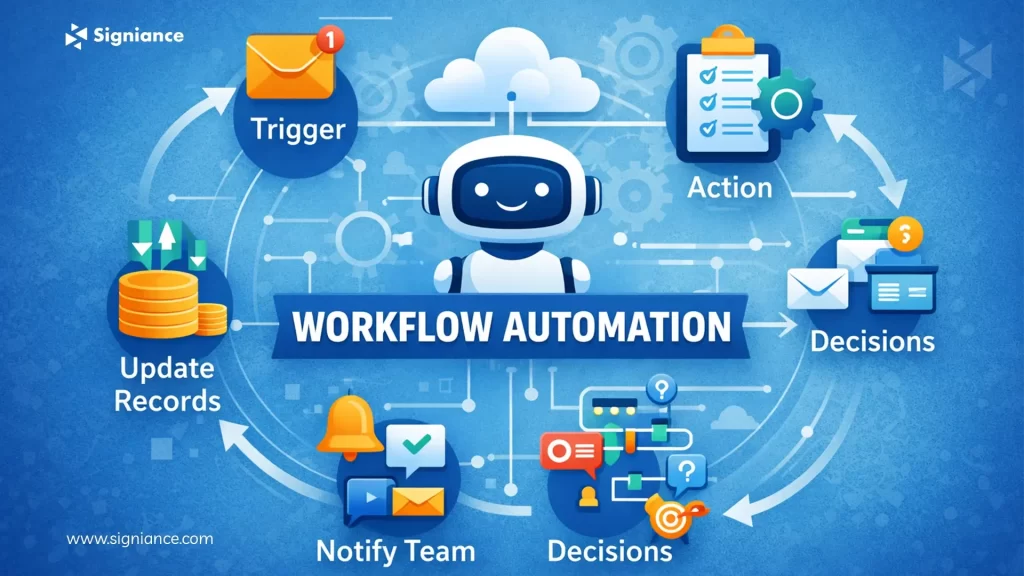
Workflow automation addresses this problem at its root. When implemented correctly, it does more than save time or reduce manual effort. It improves speed, consistency, and decision-making across the business. This blog explains how workflow automation drives revenue, where it has the biggest impact, and how growing companies should approach it to support sustainable growth.
Understanding Workflow Automation Beyond Cost Savings
Why automation is a revenue enabler, not just an efficiency tool
Workflow automation is often positioned as a cost-cutting initiative. Automate tasks, reduce manual work, and improve operational efficiency. While this is true, it is only part of the picture.
At its core, workflow automation is about how information, decisions, and actions move across teams. When workflows are manual or fragmented, work slows down. Delays accumulate, errors increase, and accountability becomes unclear. These issues directly affect revenue, even if they do not appear as line items.
Automation creates structured, repeatable flows where tasks move predictably from one stage to the next. This predictability enables faster execution, clearer ownership, and better visibility. Over time, these improvements translate into higher conversion rates, shorter sales cycles, and improved customer lifetime value.
Companies that view workflow automation as a revenue enabler design it around outcomes, not tasks.
Faster Execution Means Faster Revenue
Reducing cycle time across sales, operations, and delivery
Speed plays a critical role in revenue generation. The longer it takes to respond to a lead, onboard a customer, or deliver a service, the greater the risk of drop-off.
Workflow automation reduces friction across key revenue-driving stages:
In sales, automated lead routing ensures inquiries reach the right person without delay. Follow-ups are triggered consistently, reducing the chance of missed opportunities. Deal approvals move faster when workflows replace ad-hoc communication.
In onboarding, automation ensures that customers receive consistent guidance, documentation, and access without waiting for manual intervention. Faster onboarding means customers reach value sooner, which improves retention and upsell potential.
In delivery and fulfillment, automated workflows reduce handoff delays and ensure tasks move forward even when teams are busy. This shortens time to revenue and improves overall throughput.
Speed does not just improve efficiency. It directly impacts how quickly revenue is realized and how much revenue is ultimately captured.
Consistency Builds Trust and Repeat Business
Why predictable workflows improve customer retention
Revenue growth is not only about acquiring new customers. Retention, renewals, and repeat business play a major role, especially as companies scale.
Manual workflows introduce inconsistency. Two customers may receive different experiences depending on who handles their request or how busy the team is. Over time, this inconsistency erodes trust.
Workflow automation introduces standardization. Processes are executed the same way every time, regardless of volume. This consistency improves reliability and sets clear expectations for customers.
When customers experience predictable onboarding, timely communication, and reliable delivery, trust increases. Trusted relationships lead to renewals, referrals, and upsell opportunities.
From a revenue perspective, consistency reduces churn and increases lifetime value. Automation helps create that consistency without adding operational burden.
Better Data Flow Leads to Better Revenue Decisions
Turning operational signals into revenue insights
Revenue decisions rely on data. Pricing adjustments, sales prioritization, and forecasting all depend on accurate and timely information.
Manual workflows often fragment data. Information is stored across tools, updated inconsistently, or shared informally. This makes it difficult for leadership to see what is actually happening in the business.
Automated workflows improve data flow by capturing information at each step. Lead status, conversion times, onboarding progress, and customer interactions become visible and measurable.
This visibility enables better decision-making. Teams can identify bottlenecks, understand which channels perform best, and allocate resources more effectively. Leaders gain confidence in forecasts and can act proactively rather than reactively.
Better data does not guarantee better revenue outcomes, but poor data almost always limits growth. Workflow automation creates the foundation for informed revenue decisions.
Scaling Revenue Without Scaling Headcount
How automation decouples growth from hiring
One of the biggest challenges for growing companies is scaling revenue without proportionally increasing costs. Hiring more people to manage growing workloads quickly erodes margins.
Workflow automation helps decouple revenue growth from headcount growth. By reducing manual effort and improving throughput, teams can handle higher volumes without burning out.
For example, automated lead qualification allows sales teams to focus on high-intent prospects instead of manually filtering inquiries. Automated billing and renewals reduce administrative workload while improving accuracy. Automated support workflows help teams resolve issues faster without expanding support staff.
This leverage is critical for sustainable growth. Companies that automate effectively protect margins while continuing to scale revenue.
Where Workflow Automation Impacts Revenue the Most
High-impact workflows worth automating first
Not all workflows contribute equally to revenue. Companies should prioritize automation where it has the most direct impact.
Lead management and qualification
Automating lead capture, scoring, and routing ensures faster response times and higher conversion rates.
Sales follow-ups and handoffs
Automated reminders and structured handoffs reduce dropped deals and improve close rates.
Customer onboarding
Automation ensures customers reach value quickly, which improves retention and upsell potential.
Billing and renewals
Automated invoicing, reminders, and renewals reduce revenue leakage and improve cash flow.
Support escalation and resolution
Well-designed support workflows improve satisfaction and retention, indirectly driving revenue.
Focusing on these areas creates quick wins while laying the groundwork for broader automation.
Common Automation Mistakes That Block Revenue
Why poor automation can slow growth
Workflow automation does not automatically lead to better outcomes. Poorly designed automation can actually harm revenue.
Automating broken processes is a common mistake. If a workflow is unclear or inefficient, automation simply accelerates the problem.
Over-automation is another risk. Removing human judgment from workflows that require nuance can damage customer relationships and trust.
Lack of ownership is also an issue. Automated workflows still need monitoring and improvement. Without clear ownership, they degrade over time.
Successful automation balances structure with flexibility. It supports people rather than replacing them entirely.
Conclusion
Workflow automation is often framed as an operational improvement, but its impact goes far beyond efficiency. By improving speed, consistency, and decision-making, automation directly supports revenue growth.
Companies that align workflow automation with revenue-driving processes create systems that scale without chaos. They move faster, deliver more consistently, and make better decisions as complexity increases.
The key is intention. Automation should be designed around outcomes, not tools. When done right, it turns operational clarity into a real growth advantage.
If revenue growth is a priority, start by examining how work flows across your organization. Identify where delays, inconsistencies, or manual effort are slowing momentum.
Well-designed workflow automation can transform efficiency into sustained revenue growth when approached with clarity and structure.