
From “Pilot Purgatory” to 2x Revenue Growth
The “gold rush” era of Artificial Intelligence is over. In 2024, enterprises were frantic, throwing budgets at every LLM (Large Language Model) that promised efficiency. By 2026, the dust has settled, and a harsh reality has emerged: 90% of AI prototypes never make it to production.
For the modern enterprise, the challenge isn’t “finding” AI, it’s adopting it in a way that is secure, scalable, and, most importantly, profitable. This guide is designed for C-suite executives and IT directors who are tired of “cool demos” and are ready for a bottom-line transformation.
We will explore how to re-engineer your organizational DNA to support AI that doesn’t just “chat” but actually drives a 2x revenue multiplier.
The Problem Statement: Why Enterprise AI Fails
Before we look at the solution, we must diagnose the disease. Most Enterprise AI projects fail because they are treated as IT projects rather than Business Transformations.
The “Pilot Purgatory” Trap
Organizations often find themselves with dozens of “successful” pilots that never scale. Why? Because a pilot in a vacuum doesn’t account for:
- Data Fragmentation: The AI works on a clean CSV file but fails when connected to a messy, legacy ERP system.
- The Trust Gap: Employees fear that “AI adoption” is a euphemism for “downsizing,” leading to subtle sabotage or lack of engagement.
- Hidden Costs: The “API tax” of using public models can quickly spiral, making the solution more expensive than the problem it solves.
The Three Pillars of Successful Adoption
Pillar I: The Data Fabric (Your Competitive Moat)
In the world of Enterprise AI, the model (GPT, Claude, Llama) is a commodity. Your data is your only true differentiator.
- Retrieval-Augmented Generation (RAG): Instead of training a model from scratch (which costs millions), 2026 winners use RAG. This allows the AI to “look up” your private company documents in real-time, providing answers that are grounded in your specific business logic.
- Vector Databases: You must transition from traditional SQL databases to Vector databases (like Pinecone or Milvus). This allows the AI to understand “context” rather than just “keywords.”
- Data Governance: AI requires a “Single Source of Truth.” If your marketing data contradicts your sales data, your AI will hallucinate.
Pillar II: Hybrid Infrastructure & Security
The “Public Cloud Only” model is dying in the enterprise space due to security concerns.
- Private LLMs: We are seeing a massive shift toward hosting open-source models (like Llama 3 or Mistral) within a company’s own VPC (Virtual Private Cloud).
- Sovereignty: For global enterprises, data must often stay within specific geographic borders. Your AI architecture must respect these “data residency” laws.
Pillar III: The “Human-in-the-Loop” (HITL) Framework
The goal of Enterprise AI isn’t automation; it’s augmentation.
- The AI Co-Pilot: Every employee should have an AI assistant that handles the “drudge work” (data entry, scheduling, initial drafting).
- Approval Gates: For high-stakes decisions (legal, financial, medical), the AI proposes, but a human must click “Approve.” This mitigates liability and ensures quality.
How AI Adoption Doubles Revenue
This is where the “Click” becomes a “Conversion.” Leaders want to know how this impacts the P&L.
A. Collapsing the Sales Cycle
AI-driven “Hyper-Personalization” allows sales teams to send thousands of perfectly tailored, research-backed pitches in the time it used to take to send ten. By predicting a lead’s “Intent Signal” through web behavior, enterprises are seeing a 40% increase in lead-to-close velocity.
B. Supply Chain Elasticity
By using predictive AI to analyze global logistics, weather, and geopolitical shifts, enterprises can move from “Just-in-Time” to “Predictive” inventory. This reduces waste by 25% and ensures that you never miss a sale due to a stock-out.
C. Creating New “AI-First” Products
The most successful companies aren’t just using AI to save money; they are using it to build new products. For example, a software company might add an “AI Consultant” layer to their platform, creating a new high-margin subscription tier.
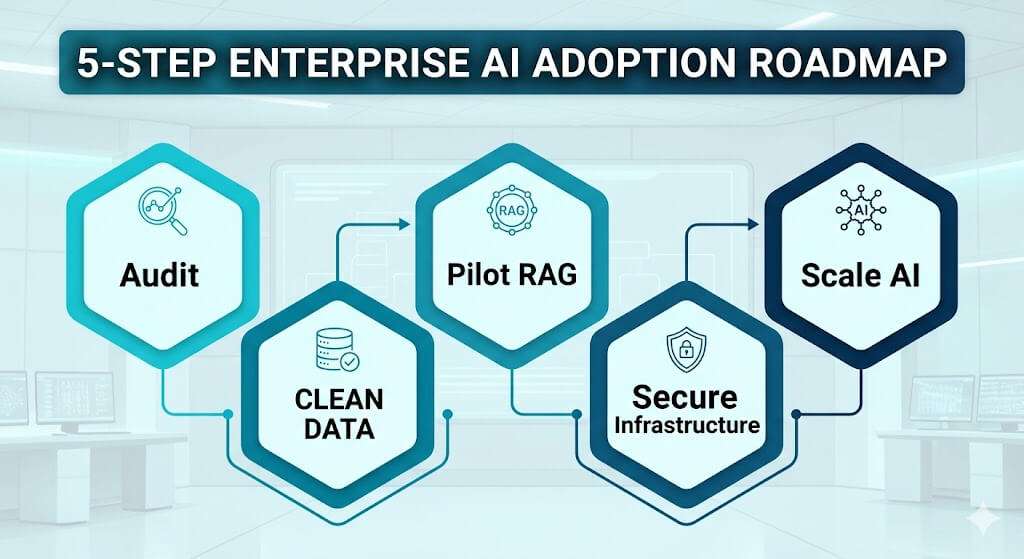
The 5-Step Roadmap to Implementation
- The Audit: Identify the “high-volume, low-complexity” tasks in your organization.
- The Foundation: Build your Vector database and clean your core data.
- The Pilot: Launch one specific use case (e.g., AI for Customer Support or AI for Legal Review).
- The Security Layer: Implement robust “Prompt Injection” protection and data masking.
- The Scale-Up: Roll out the infrastructure to the rest of the departments.
Conclusion: The Execution Gap
The difference between a market leader and a laggard in 2026 is the Execution Gap. The technology is available to everyone; the ability to integrate it into a complex, human-led organization is the rare skill.
Enterprise AI is not a destination; it is a continuous process of refinement. The companies that start building their “Data Moat” today are the ones that will be untouchable by 2030.Stop experimenting and start scaling. Is your enterprise infrastructure holding back your AI potential? At Signiance, we specialise in bridging the gap between cutting-edge AI research and real-world business profitability.