
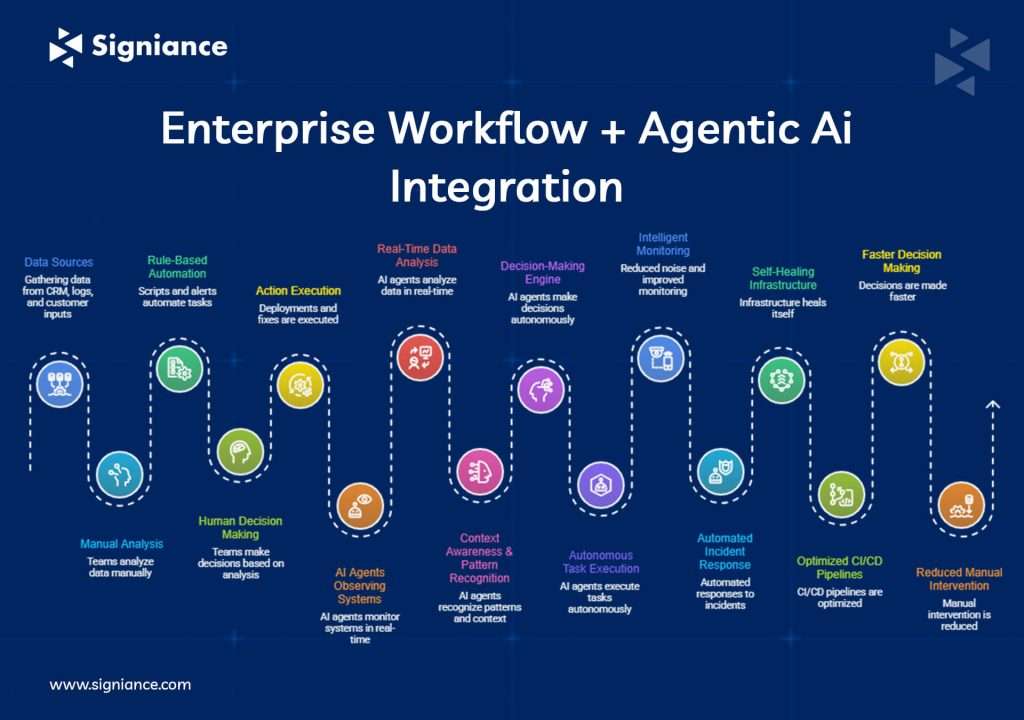
Understanding the Shift from Manual Operations to Intelligent Workflows
At an early stage, most enterprise workflows feel efficient. Teams have clear processes, tools are well integrated, and automation appears to be doing its job.
But as the system grows, things start to change. The number of alerts increases. Dependencies become harder to track. Teams spend more time fixing issues than building new solutions. What once felt structured slowly turns into something reactive and difficult to manage.
This is not because enterprises lack tools or talent. It happens because the way workflows are designed does not evolve with scale. To understand how to fix this, we first need to understand where the breakdown actually begins.
Problem Statement
Most enterprise workflows are built on a simple idea: define rules, automate tasks, and involve humans when decisions are required.
At a smaller scale, this works well. But as systems expand, the same approach begins to show its limits.
Teams often find themselves digging through logs to understand what went wrong. Monitoring tools generate alerts, but they don’t always provide clarity. Engineers step in to analyze situations, make decisions, and execute fixes. Over time, this creates a constant loop of reacting to problems.
The real issue is not automation itself. It is the lack of adaptability.
Traditional workflows can follow instructions, but they cannot adjust to changing conditions on their own. As a result, every unexpected situation requires human attention, which slows everything down.
How Traditional Workflows Start Slowing Down
In most enterprise environments, workflows follow a familiar pattern. Data flows in from different systems, teams analyze it, and predefined rules trigger certain actions. When something unusual happens, engineers step in to make decisions and resolve the issue.
This model depends heavily on human involvement at critical points. As long as the system remains predictable, this is manageable. But modern systems are rarely predictable.
As traffic increases, integrations grow, and user behavior becomes more dynamic, the number of edge cases rises. Suddenly, the workflow is no longer smooth. It becomes a series of interruptions that require constant attention.
This is where scaling becomes difficult. Not because the system cannot handle load, but because the workflow cannot handle complexity.
What Changes When Workflows Become More Adaptive
To handle this complexity, workflows need to move beyond fixed rules.
Instead of waiting for someone to analyze and act, systems need the ability to continuously observe what is happening, understand patterns, and respond accordingly.
This is where a more adaptive approach comes in.
With systems that can analyze data as it arrives and recognize changes in behavior, the dependency on manual decision-making begins to reduce. Instead of reacting to alerts, the system starts responding to situations as they develop.
The key shift here is simple but important: decisions are no longer delayed until a human steps in.
How This Fits into Enterprise Systems
When this approach is applied, the workflow begins to change in subtle but powerful ways.
Monitoring is no longer just about collecting data; it becomes a continuous understanding of system behavior. Patterns that once required manual investigation are identified early. Decisions that previously took time are made faster because they are based on real-time context.
Tasks like scaling resources, handling minor failures, or adjusting configurations no longer need constant supervision. They happen as part of the system’s natural operation.
Over time, this creates a workflow that feels less reactive and more stable.
The Difference in Day-to-Day Operations
The impact of this shift is noticeable in everyday operations.
Teams spend less time investigating recurring issues because many of them are handled automatically. Alerts become more meaningful instead of overwhelming. Decisions are supported by context rather than guesswork.
Most importantly, engineers are no longer pulled into every small problem. They can focus on improving systems instead of constantly maintaining them.
This does not remove human involvement. It simply places it where it matters most.
What Enterprises Gain from This Shift
As workflows become more adaptive, enterprises start seeing improvements beyond just efficiency.
Systems become easier to manage because they are not constantly breaking under pressure. Downtime reduces because issues are addressed earlier. Decision-making becomes faster because it is supported by real-time understanding.
This also makes scaling more practical. Instead of increasing team size to manage complexity, organizations can rely on systems that handle a portion of that complexity on their own.
What Needs to Be Considered Before Adopting This Approach
While the benefits are clear, this shift requires careful implementation.
Enterprises need to define where automated decisions are appropriate and where human oversight is necessary. Existing tools and workflows must be aligned with this new approach. Teams need visibility into how decisions are made so they can trust the system.
This is not about replacing what already exists. It is about improving how it works.
Conclusion
Enterprise workflows do not fail suddenly. They gradually lose efficiency as complexity increases.
The challenge is not the lack of automation, but the way decisions are handled within that automation.
By moving towards workflows that can observe, understand, and respond in real time, enterprises can reduce dependency on constant manual intervention and create systems that remain stable as they grow.
The goal is not to remove humans from the process, but to allow them to focus on the work that truly requires their attention.
If your current workflows feel harder to manage as your systems grow, it may be time to rethink how decisions are being made within them.
At Signiance, we work with enterprises to design workflows that are easier to scale, more stable, and better aligned with real-world complexity.
Let’s connect and explore what this could look like for your business