
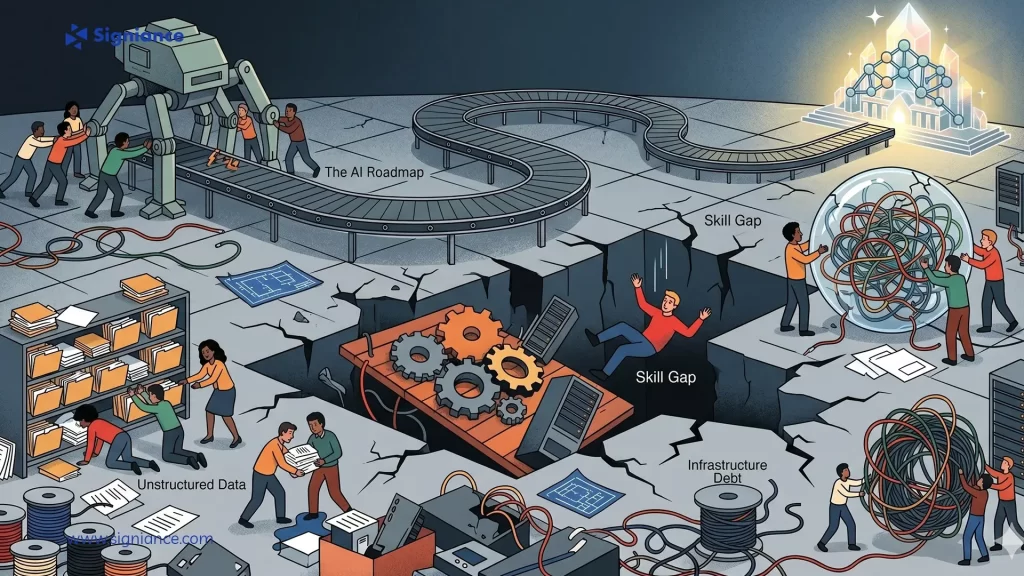
The Hidden Stage Where AI Projects Are Won or Lost
Startups are pouring money, time, and talent into AI, yet a large share of these initiatives never deliver a measurable return. The reason usually has nothing to do with the AI model itself.
It has everything to do with what happens, or doesn’t happen, before the first model is ever trained. Call it Stage Zero: the planning and discovery phase that most founders rush through because they’re excited to start building. Skip it, and every later stage inherits the cracks.
Every founder has heard some version of the same advice: “you need AI in your business, or you’ll be left behind.” So teams move fast. They pick a tool, hire a contractor, or task an engineer with “adding AI somewhere” into the product. Months later, they have a working model and no clear sense of whether it actually helped the business.
This isn’t a talent problem or a technology problem. It’s a sequencing problem. AI workflows fail at Stage Zero, the planning stage, far more often than they fail during development or deployment. The mistakes made here are invisible at first and expensive later, because by the time they surface, a startup has already committed budget, built around a tool, or reorganized a team’s workflow around a flawed assumption.
In this post, we’ll break down the five most common problems that derail startups at Stage Zero, why each one is so easy to miss, and what to do instead.
The 5 Problems That Sink AI Workflows Before They Start
1. No Clear Problem Definition
The most common failure point is also the simplest to avoid: teams start with “how can we use AI?” instead of “what business problem are we actually trying to solve?” That single inversion changes everything downstream. A team chasing a technology in search of a use case will almost always end up with a model that’s technically impressive and commercially irrelevant, a chatbot nobody needed, a prediction engine that doesn’t tie to a single revenue or cost metric.
The best AI projects start from a specific, painful, well-understood problem. Founders who can finish the sentence “this is costing us X hours or X dollars every month” are already ahead of most of the market.
2. Messy or Insufficient Data
AI is only as good as the data behind it, and most startups underestimate this until they’re already mid-project. Customer records live in three different tools. Historical data was never logged consistently. Labels are missing or inconsistent. None of this is visible during the planning conversation, it only becomes visible once an engineer actually tries to build on top of it.
This is why a data audit belongs at Stage Zero, not Stage Three. Even a rough inventory of what data exists, where it lives, and how clean it is, can save months of rework later. A smart, well-designed model trained on poor data will always underperform a simple model trained on good data.
3. No Success Metrics Defined Upfront
Ask most teams how they’ll know if their AI project worked, and you’ll get a vague answer. “It’ll save time.” “It should help conversion.” Without a number attached, before the project starts, there’s no way to prove impact after it ships. And without proof, AI initiatives become very easy to deprioritize or quietly kill the next time budgets get tight.
Defining success metrics on day one, cost savings, time reduction, conversion lift, customer satisfaction, forces clarity earlier and gives the whole team a finish line to build toward instead of an open-ended experiment.
4. Underestimating Integration Complexity
Building or buying the model is frequently the easy part. The harder part is everything around it: connecting it to existing systems, fitting it into a team’s daily workflow, and getting people to actually trust and use it. A perfectly accurate model that nobody adopts delivers zero business value.
Startups that plan for integration and change management at Stage Zero, not as an afterthought, ship AI that actually gets used. That means mapping the current workflow, identifying where the new tool plugs in, and deciding early who owns adoption.
5. Build vs. Buy Confusion
Founders tend to default to one extreme: build everything in-house because it feels more controllable, or buy an off-the-shelf tool because it feels faster. Neither decision is automatically right, and making it without a real evaluation of cost, timeline, in-house skillset, and long-term flexibility can quietly burn through months of runway.
The right answer depends entirely on the startup’s stage, budget, and the uniqueness of the problem being solved. A generic need, like customer support automation, rarely justifies building from scratch. A core, differentiated capability often does. This decision deserves a deliberate framework, not a gut call made under deadline pressure.
The Solution: Treat Stage Zero as Its Own Project
Every one of these five problems shares the same root cause: skipping or rushing the planning stage. The fix isn’t more AI expertise, it’s more discipline before the AI work begins. In practice, that means treating Stage Zero as a deliverable in its own right, with its own time and its own checklist, rather than a quick conversation before the “real” work starts.
A solid Stage Zero checklist looks like this:
- Write down the specific business problem in one sentence, with a number attached to its cost or impact.
- Audit the data you actually have, not the data you assume you have.
- Define what success looks like in measurable terms before any model is built.
- Map how the solution will integrate into existing workflows and who is responsible for adoption.
- Evaluate build versus buy against your actual budget, timeline, and in-house skillset, not instinct.
Startups that work through this list before writing a single line of code consistently ship AI that sticks, because every later decision is built on a foundation that was actually tested, not assumed.
Conclusion
AI doesn’t fail startups. Poor planning does. The five problems covered here, unclear problem definition, messy data, missing metrics, underestimated integration, and build-versus-buy confusion, all trace back to the same root cause: treating Stage Zero as a formality instead of the most important phase of the entire project.
Founders who slow down at the start end up moving faster overall. They spend less time reworking broken assumptions and more time building something that actually moves the business forward. The fastest path to AI that works isn’t skipping the planning stage, it’s taking it seriously.
Ready to Get Stage Zero Right?
At Signiance Technologies, we help startups and growing businesses navigate exactly this stage, defining the right problem, auditing data readiness, setting measurable goals, and choosing the right build-versus-buy path, before a single resource is wasted on the wrong AI investment. If you’re planning your AI roadmap and want to make sure Stage Zero is bulletproof, let’s talk.