
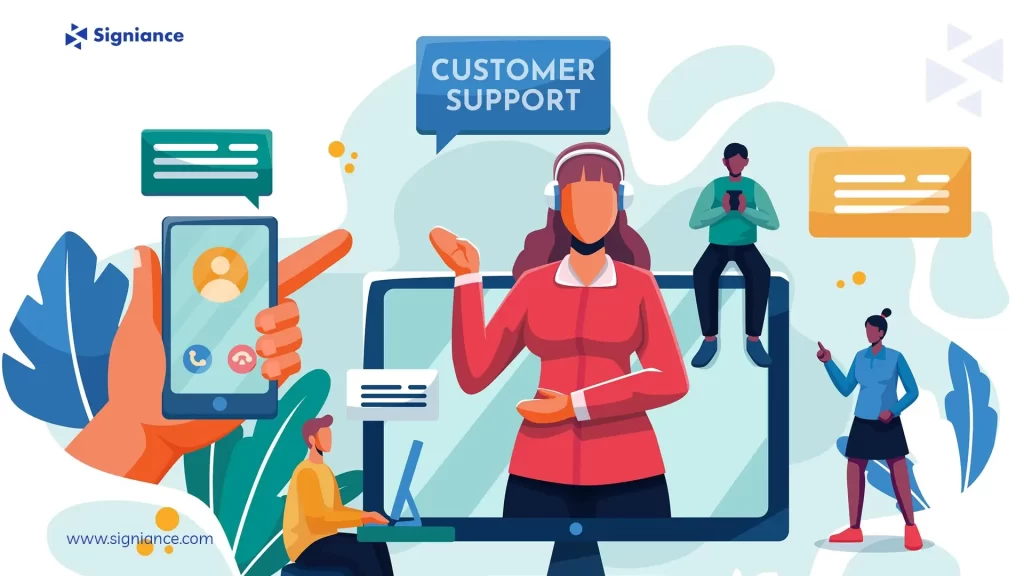
When Your Support Queue Becomes a Growth Problem
There’s a particular kind of panic that hits a startup around Series A. The product is working, users are coming in fast, and then the support inbox starts looking like a flood response operation. What was a manageable queue of 500 tickets a week becomes 5,000, then 15,000, and the team that used to handle it with pride and personal touch is suddenly drowning.
Hiring more agents feels like pouring water into a leaking bucket. The economics don’t work, and more importantly, the quality suffers.
This is not a rare story. It’s practically a rite of passage for startups that find product-market fit before they find operational maturity. The assumption that support just scales linearly with headcount is one of the most expensive myths in the early-stage playbook.
What scales linearly is cost. Quality, response time, and consistency tend to collapse well before that.
The startups that navigate this transition well have something in common: they treat support as an engineering problem, not just a hiring problem. They instrument it, they model the failure modes, and they bring AI into the stack thoughtfully, not desperately.
There’s a meaningful difference between bolting a chatbot onto your help center and actually architecting an AI-driven support system that handles volume, learns from patterns, and keeps humans in the loop where it matters.
This piece is about what that journey actually looks like: the decisions, the trade-offs, the architecture choices, and the places where startups get it right or spectacularly wrong. If you’re somewhere between your first 500 tickets and your next 50,000, this is for you.
Solution Overview
The core shift that makes AI for startup customer support at scale work is moving from reactive ticket handling to a layered intelligence system. At its simplest, that means: automated triage and classification at the front, AI-assisted or fully automated resolution in the middle, and escalation with full context to human agents at the end. Every layer has a job, and every layer has to be designed, not assumed.
The tools exist. Large language models, retrieval-augmented generation, intent classification, sentiment analysis, and workflow automation have all matured enough to be production-ready for support use cases.
The question for most startups isn’t whether the technology works. It’s whether they’ve built the right foundation to use it well, and whether they know where the boundaries are.
The Growth Trap: Why Linear Hiring Doesn’t Work
When a startup’s ticket volume doubles, the instinct is to hire. And for a while, that works. But the math changes fast. Every new support agent needs onboarding, tooling, supervision, and time to reach full productivity. At 500 tickets a week, you can absorb that overhead.
At 5,000 tickets a week, you’re managing a small department. At 50,000, you’re running a call center, and the unit economics of your product are quietly falling apart in the background.
The more insidious problem is consistency. Human support at scale, without strong process and AI augmentation, produces variable quality. One agent gives a thorough answer. Another sends a boilerplate response.
A third escalates something that didn’t need escalating. Customers notice, and your CSAT scores tell the story before your team does.
The companies that break this pattern early are the ones that ask a different question. Instead of “how many agents do we need,” they ask “what does our support function need to look like at 10x volume, and what would it take to get there without 10x cost.”
That reframe is where AI enters the picture correctly, as a structural solution rather than a band-aid.
Triage First: Classification Is the Foundation
The first and most underrated application of AI in support at scale is not answering tickets. It’s sorting them. Smart classification, routing tickets by type, urgency, product area, sentiment, and customer tier, is what makes everything else work.
Without good triage, even a well-designed AI resolution system falls apart. You’re asking a model to answer questions without knowing what kind of question it’s dealing with.
You’re routing billing issues to technical agents and API questions to account managers. Every misroute creates either a frustrated customer or an overburdened agent.
Building a solid classification layer usually requires a few hundred labeled examples, a fine-tuned or prompted model for intent detection, and a routing engine that knows what to do with each category.
The payoff is disproportionate to the effort. When tickets land in the right queue immediately, resolution times drop, escalation rates drop, and your AI resolution layer has a much cleaner problem to solve.
AI Resolution: Where the Leverage Actually Lives
Once you have good classification, you can start automating resolution for the categories where that makes sense. And this is where startups either build something powerful or build something that erodes customer trust inside two weeks.
The patterns that work well for full automation tend to share a few characteristics: the question has a bounded, factual answer, the answer is findable in your existing documentation or data, and a wrong answer is low-stakes enough to correct easily.
Password resets, order status, account settings, plan comparisons, integration documentation, common error codes: these are AI territory.
The patterns that need human oversight are the ones where context matters, where the customer’s emotional state matters, where policy judgment is involved, or where a wrong answer has real downstream consequences.
A churning enterprise customer asking a pointed question about SLA violations is not a use case for unreviewed AI resolution, no matter how well your model is performing.
The best implementations use a confidence threshold. High-confidence, low-stakes answers get sent automatically. Medium-confidence answers get surfaced to an agent as a suggested response that they can review and send in seconds.
Low-confidence or flagged-sentiment tickets go straight to a human with full context already assembled. That three-tier model keeps automation rates high while keeping quality in check.
Retrieval-Augmented Generation and the Knowledge Base Problem
One of the most common failure modes in AI support systems is a model that answers confidently from its training data rather than from your actual documentation. It will tell customers about features you don’t have, pricing you’ve changed, and policies you deprecated six months ago.
This is the hallucination problem applied to support, and it’s genuinely bad for customer trust.
The solution is retrieval-augmented generation, or RAG. Instead of relying on a model’s parametric memory, you connect it to your actual knowledge base, your documentation, your FAQs, your changelog, your internal runbooks.
When a ticket comes in, the system retrieves the most relevant source material and grounds the model’s response in that content.
This requires investment. Your knowledge base needs to be well-structured, up to date, and chunked in a way that retrieval systems can work with. Many startups discover at this point that their documentation is in worse shape than they thought, scattered across Notion, Confluence, Google Docs, and two generations of help center articles. Cleaning that up before you build your RAG layer isn’t optional, it’s foundational. The quality of your AI responses will be exactly as good as the quality of your source material.
Human-in-the-Loop: Where Judgment Still Wins
AI support doesn’t mean removing humans from the equation. It means repositioning them. The agents who were spending 80% of their time on repetitive tier-one queries are now the people handling complex, sensitive, high-value interactions.
Their judgment is worth more, their job is more interesting, and paradoxically, customer satisfaction often improves on the tickets they do handle because they’re not exhausted from doing the same thing 200 times a day.
The handoff architecture matters enormously. When a ticket escalates from AI to human, the agent needs full context: what the customer asked, what the AI understood, what it tried to resolve, what failed, and what the customer’s history looks like.
A bare ticket with “I need to speak to a human” tells the agent almost nothing. A ticket that arrives with a structured summary, the relevant account data pulled in, and a suggested starting point lets them get to resolution in a fraction of the time.
Building this escalation context layer properly is one of the highest-leverage investments a startup can make in its support architecture. It’s also one of the most commonly skipped because it feels like polish rather than infrastructure. It isn’t.
Metrics, Feedback Loops, and Continuous Improvement
An AI support system that doesn’t learn from its own outcomes is not a system, it’s a static deployment. The difference between a support function that holds its quality at 50,000 tickets and one that degrades slowly is whether it has the feedback infrastructure to keep improving.
The metrics that matter most at this stage are not the ones that sound impressive in a board deck. Automation rate tells you how much the AI is handling, but it doesn’t tell you whether it’s handling things well.
CSAT on AI-resolved tickets, escalation rate by category, and time-to-resolution by channel give you a much more honest picture of health.
Feedback loops need to be built deliberately. Agent corrections, customer ratings, and escalation patterns should all feed back into your classification model and your resolution quality.
If a particular ticket type is being automated confidently but escalating at high rates, something is wrong and you want to know about it before it shows up in churn data. Regular audit cycles, where a human reviews a sample of AI-resolved tickets, are not optional. They’re the mechanism by which your system actually improves.
Conclusion
The journey from 500 tickets to 50,000 is not a support operations challenge with an AI component. It’s an engineering and architecture challenge with a support context. The startups that get through it well are the ones that invest early in the right foundations: classification, knowledge infrastructure, confidence-based automation, and human escalation paths that are designed, not improvised.
AI for startup customer support at scale is not about replacing your team. It’s about building a system where your team’s time goes to the interactions that genuinely require their judgment, while everything routine is handled consistently, instantly, and in a way that scales without breaking the economics of your business.
At Signiance Technologies, we’ve worked with startups navigating exactly this kind of operational inflection point. Whether the challenge is architecture design, knowledge infrastructure, integration into existing tooling, or building the feedback loops that keep the system improving, we bring the kind of hands-on cloud and AI engineering experience that makes the difference between a support function that scales and one that becomes a liability.
If your support queue is starting to outpace your team, the time to build the right architecture is before the next growth curve, not during it. Reach out to Signiance Technologies to talk through where you are and what a well-designed AI support system would look like for your specific stage and stack. Let’s build it right.