
A Practical Guide for Startup Founders
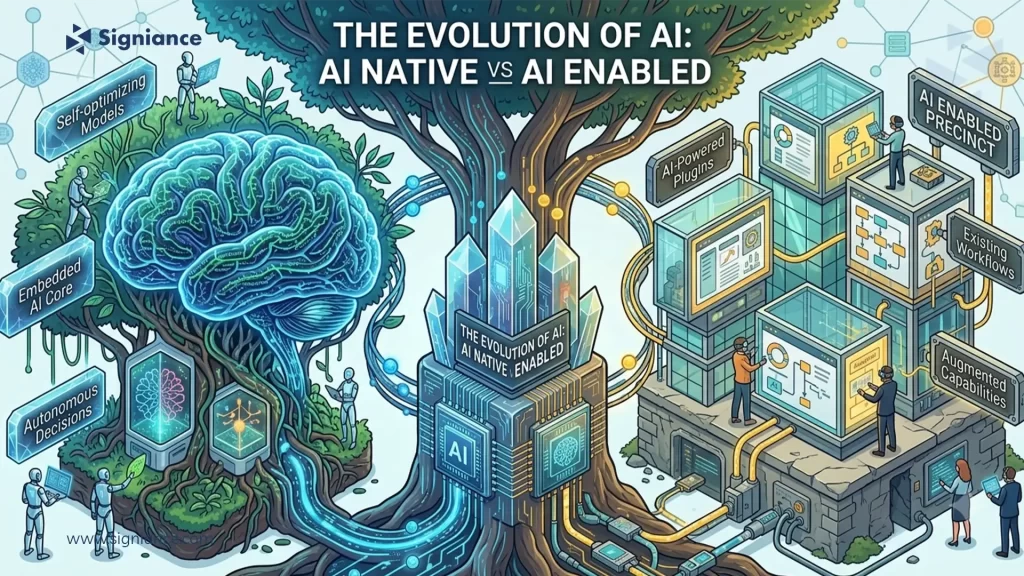
Artificial Intelligence is now part of almost every software product, but not every AI product is built the same way. Many companies claim to be AI powered, while only a few are truly AI Native. In this guide, you’ll learn the real difference between AI Native and AI Enabled products, how each approach impacts your business, and which path makes the most sense for your startup.
Table of Contents
- Why This Topic Matters
- How to Decide Between AI Native and AI Enabled
- When Should You Build AI Native?
- Top 7 Differences Between AI Native and AI Enabled
- Related Resources
- Summary
Why This Topic Matters
- Better Investment: Choosing the wrong AI strategy can waste months of engineering effort and product budget.
- Faster Growth: Understanding the difference helps founders prioritize features that customers actually value.
- Stronger Product: AI Native products create competitive advantages that are difficult to copy.
- Smarter Decisions: Technical leaders can design systems that scale instead of adding AI as an afterthought.
- Future Ready: AI adoption is accelerating, making architecture decisions more important than ever.
How to Decide Between AI Native and AI Enabled
| Business Goal | Recommended Approach | Reason |
|---|---|---|
| Add AI to an existing SaaS product | AI Enabled | Faster implementation with minimal architectural changes |
| Build a new AI startup | AI Native | AI becomes the foundation of the product |
| Improve customer support | AI Enabled | Existing workflows can be enhanced quickly |
| Launch an AI assistant | AI Native | Intelligence is the primary value proposition |
| Automate repetitive business tasks | AI Enabled | Lower cost with faster deployment |
| Create autonomous workflows | AI Native | Requires AI driven decision making from the start |
When Should You Build AI Native?
| Business Stage | Recommended Timing | Why |
|---|---|---|
| Idea Validation | AI Enabled | Validate customer demand before investing heavily |
| MVP Development | Depends on product | AI Native if AI is the core offering |
| Product Market Fit | AI Native | Build a scalable AI architecture |
| Growth Stage | AI Native | Improve automation and competitive advantage |
| Enterprise Expansion | AI Native | Support complex workflows and intelligent decision making |
Top 7 Differences Between AI Native and AI Enabled
1. Product Foundation
- AI First: AI Native products are designed around intelligence from day one.
- Feature Addition: AI Enabled products add AI into an existing application.
- Architecture Difference: AI Native systems are built to support continuous AI interactions.
- Business Focus: AI becomes the primary product instead of an extra feature.
- Customer Value: Users expect intelligent behavior throughout the application.
2. Software Architecture
- Modern Design: AI Native products use modular architectures built for AI workflows.
- Data Pipelines: Continuous data processing is a core requirement.
- Model Integration: AI models are tightly integrated into product logic.
- Traditional Stack: AI Enabled products usually connect external AI APIs.
- Lower Complexity: Existing software architecture remains mostly unchanged.
3. User Experience
- Dynamic Responses: AI Native applications continuously adapt to user behavior.
- Context Awareness: Previous interactions improve future experiences.
- Predictive Actions: AI proactively assists users instead of waiting for commands.
- Static Workflow: AI Enabled software performs isolated AI tasks.
- Limited Learning: Most improvements rely on manual product updates.
4. Scalability
- Built for Growth: AI Native systems handle increasing AI workloads efficiently.
- Continuous Learning: Models improve as more data becomes available.
- Workflow Automation: Complex decisions become automated over time.
- API Dependency: AI Enabled products often rely on third party AI services.
- Performance Limits: Scaling becomes harder as AI usage increases.
5. Development Approach
- Cross Functional Teams: AI engineers, cloud architects, and software developers work together.
- Infrastructure Planning: Cloud architecture supports AI workloads from the beginning.
- Experimentation: Continuous testing improves model performance.
- Incremental Delivery: AI Enabled features are released individually.
- Lower Initial Cost: Existing products require fewer changes.
6. Business Value
- Competitive Advantage: AI Native businesses create unique capabilities.
- New Revenue: AI itself becomes the product customers pay for.
- Higher Retention: Intelligent products improve customer engagement.
- Operational Efficiency: AI Enabled solutions reduce repetitive work.
- Faster ROI: Smaller AI projects often deliver immediate business value.
7. Long Term Strategy
- Future Expansion: AI Native platforms support advanced automation.
- Innovation Ready: New AI capabilities can be adopted faster.
- Continuous Improvement: Learning systems become more valuable over time.
- Short Term Wins: AI Enabled products solve immediate business challenges.
- Migration Path: Many successful companies begin AI Enabled before becoming AI Native.
Conclusion
AI Enabled products improve existing software with intelligent features, while AI Native products place AI at the center of every business workflow. Choosing the right approach depends on your product vision, business goals, and long term strategy. If you’re planning to build an AI Native product or modernize your existing platform, explore Signiance Technologies’ AI and AWS consulting services to accelerate your journey.