
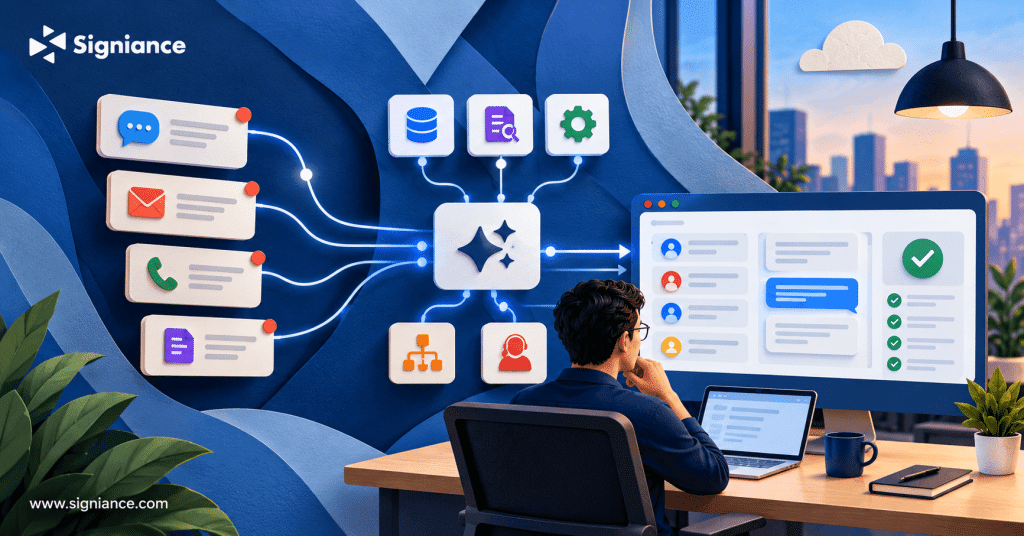
A practical architecture for turning incoming support requests into verified answers, safe actions, and measurable resolutions
Table of Contents
1. Topic Introduction: What Happens After a Ticket Arrives
2. Why AI-Native Support Architecture Matters
3. How the Platform Works End to End
4. When to Introduce Each Capability
5. 7 Components From Ticket to Resolution
6. Conclusion
What Happens After a Ticket Arrives
A customer reports that their subscription was charged twice. A traditional workflow may send the ticket to billing, wait for an agent to search payment records, and then request approval for a refund. The delay is not only the response time. It is the number of systems and decisions required to close a straightforward case.
An AI-native platform treats the ticket as a coordinated process. It identifies the request, retrieves relevant policy and account context, proposes a safe next step, executes only permitted actions, and records the outcome. The customer sees a coherent resolution rather than a chain of disconnected handoffs.
- The central objective: Reduce avoidable handling while preserving accuracy, traceability, privacy, and clear ownership of difficult cases.
- The practical outcome: Give founders and technical leads a reference architecture they can assess against their own support volume and product complexity.
Why AI-Native Support Architecture Matters
Support automation is useful only when it improves the actual resolution process. A fast but incorrect answer can create more work than a slower, well-supported response. Architecture therefore matters as much as the model selected.
- Rising ticket complexity: Requests increasingly span billing, product usage, identity, and operational systems rather than a single FAQ.
- Fragmented customer context: Agents waste time reconstructing account history when knowledge and transactional data live in separate tools.
- Inconsistent support decisions: Different agents or bots may interpret policies differently without shared retrieval and decision rules.
- Limited audit visibility: Teams need to know what information was used, which actions occurred, and when a human approved them.
- Cost and quality balance: Automation should be judged by correct resolutions, escalations, and total handling cost, not response speed alone.
How the Platform Works End to End
A reliable platform is better understood as a sequence of services than as a single chatbot. Each stage has a clear input, an expected output, and a failure path. Keeping these boundaries explicit makes testing and troubleshooting easier.
| Stage | Engineering approach | Output / control |
| Intake | Normalize email, chat, portal, and API requests into a ticket event. | Ticket ID, channel, customer identity |
| Classification | Identify intent, urgency, language, and likely routing using rules and models. | Category and confidence signal |
| Context retrieval | Search approved knowledge sources and fetch authorized account data. | Evidence with source references |
| Decision and action | Apply policy checks before tools change records or trigger workflows. | Suggested answer or controlled action |
| Verification | Check tool results and response grounding against the request. | Verified status or escalation |
| Closure and learning | Record outcome, feedback, and evaluation data. | Audit trail and quality metrics |
On AWS, teams might combine Amazon Bedrock for model access, Amazon OpenSearch Service or another retrieval layer for knowledge search, AWS Lambda or container services for integrations, and Amazon CloudWatch for operational monitoring. These are implementation options, not mandatory components. Existing helpdesk systems can remain the interface while the new workflow runs behind them.
When to Introduce Each Capability
Start with the most frequent, low-risk requests and expand only after measuring real outcomes. A staged rollout prevents a promising demo from becoming an unreliable production dependency.
| Phase | Suggested sequence | Release gate |
| Weeks 1–2 | Audit ticket categories, baseline resolution metrics, and access permissions. | Documented use cases and risks |
| Weeks 3–4 | Implement intake, classification, and read-only retrieval. | Acceptable retrieval quality on test cases |
| Weeks 5–7 | Pilot suggested responses with human review. | Grounded answers and manageable escalation rate |
| Weeks 8–10 | Add limited actions with policy checks and rollback paths. | Verified tool outcomes and audit logs |
| Weeks 11–12+ | Expand traffic gradually and monitor live performance. | Stable quality, security, and operating costs |
This schedule is illustrative. Integrations, regulated data, multilingual support, and legacy ticket systems can extend the timeline. The right time to automate an action is after the team can prove that the action is safe, observable, and reversible where appropriate.
7 Components From Ticket to Resolution
1. Ticket Intake and Identity Verification
The platform begins by converting messages into structured work items. Before accessing customer-specific data, it must establish who is asking and what the channel is authorized to reveal.
- Channel normalization: Convert chat, email, and portal messages into consistent ticket records.
- Identity confirmation: Use existing authentication or verification procedures before exposing account details.
- Attachment handling: Scan and process files within defined size, type, and retention limits.
- Sensitive data protection: Mask or restrict personal information in prompts, logs, and analytics.
- Duplicate detection: Link repeated messages to existing incidents where confidence is sufficient.
2. Intent Classification and Smart Routing
Classification determines what the request is about and which process should handle it. A model can help interpret natural language, but deterministic rules should still govern critical priorities and restricted cases.
- Intent recognition: Separate billing, access, incident, and product questions into actionable categories.
- Priority assessment: Combine customer impact, incident signals, and service-level rules.
- Confidence thresholds: Route uncertain classifications to a human or secondary review.
- Language handling: Detect language and preserve the customer’s original meaning.
- Queue ownership: Assign responsibility clearly when automation cannot complete the request.
3. Knowledge Retrieval and Customer Context
The answer should come from current, approved information rather than the model’s memory. Retrieval connects the ticket to product documentation, policies, prior incidents, and permitted account records.
- Approved source indexing: Index maintained help articles, runbooks, and policy documents.
- Access aware retrieval: Filter results according to customer and employee permissions.
- Source freshness checks: Prefer current policies and flag outdated or conflicting documents.
- Account context lookup: Fetch only the transactional fields required for the request.
- Evidence linked answers: Keep source references available for review and troubleshooting.
4. Response Planning and Policy Controls
After gathering evidence, the system chooses whether to answer, ask for clarification, perform an action, or escalate. This decision layer prevents a conversational model from treating every request as permission to modify systems.
- Action eligibility rules: Define which ticket categories may trigger automated changes.
- Policy validation: Check refund limits, access restrictions, and required approvals.
- Clarifying questions: Request missing details before making assumptions about customer intent.
- Tool input validation: Validate parameters before calling billing, CRM, or identity APIs.
- Human approval gates: Require review for high-value, sensitive, or irreversible operations.
5. Controlled Workflow Execution
A support answer is not a resolution if the promised action never occurs. Tool execution must report success or failure and handle partial outcomes without leaving the ticket in an ambiguous state.
- Scoped service credentials: Give integrations the minimum permissions needed for each operation.
- Idempotent action design: Prevent duplicate refunds or repeated account changes during retries.
- Timeout and retry limits: Handle temporary API failures without uncontrolled repeated calls.
- Transaction outcome checks: Confirm the external system accepted and completed the requested action.
- Fallback handling: Escalate failures with the action history attached for the agent.
6. Resolution Verification and Human Escalation
The platform should verify both the factual answer and any completed action before closing the case. Human escalation is a normal operating path, not evidence that the system has failed.
- Answer grounding checks: Compare the final response with retrieved evidence and policy.
- Action confirmation: Use system-of-record responses instead of trusting generated text.
- Customer confirmation: Request acknowledgment when a case requires user validation.
- Escalation summaries: Provide agents with context, attempted steps, and unresolved questions.
- Clear closure criteria: Close tickets only when defined resolution conditions are satisfied.
7. Monitoring, Evaluation, and Continuous Improvement
Production support systems change as policies, products, and customer behavior evolve. Teams need evaluations that capture resolution quality, operational reliability, and cost over time.
- Resolution quality metrics: Track correct resolution rate, reopen rate, and customer satisfaction.
- Escalation pattern analysis: Identify categories where the system frequently lacks context or permissions.
- Model output evaluation: Test groundedness, policy compliance, and error cases before releases.
- Operational cost tracking: Measure model calls, retrieval expense, and cost per resolved ticket.
- Change management process: Version prompts, policies, retrieval indexes, and integration contracts.
Conclusion
An AI-native support platform succeeds when it connects understanding to verified action, not when it merely produces fluent replies. For startups, the strongest starting point is a narrow workflow with reliable retrieval, clear permissions, measurable outcomes, and an explicit path to a human agent.