
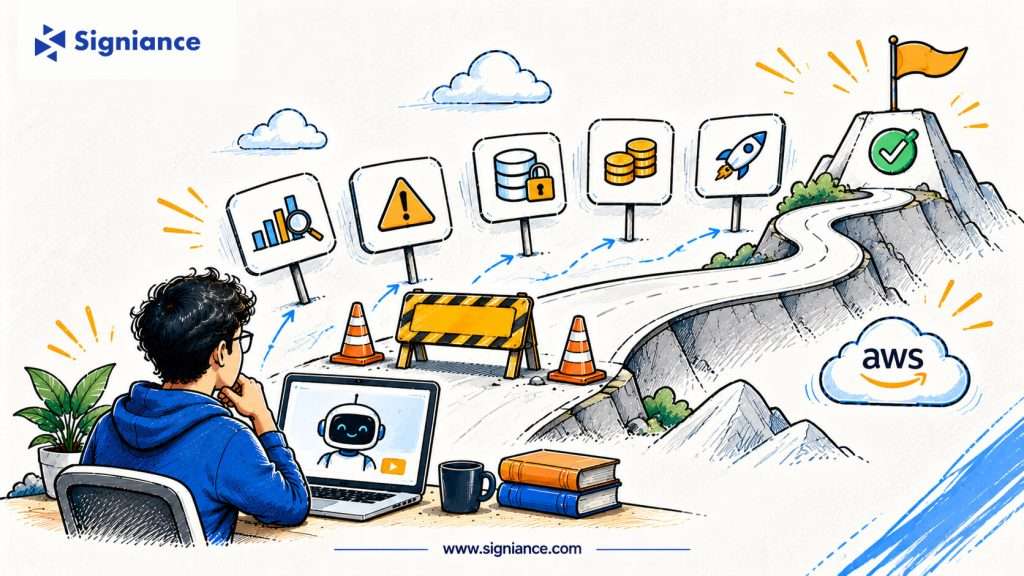
The model is rarely the problem. These five gaps keep agent demos away from real customers.
In this article
- Gap 1: Nobody defined what “working” means
- Gap 2: Failures are silent
- Gap 3: The agent has more access than it needs
- Gap 4: Nobody owns the cost
- Gap 5: There is no safe way to change it
- The pattern behind all five
- A quick self-check
- How Signiance helps
Every founder we talk to has an AI agent demo. It answers questions, books meetings, or triages support tickets, and in the demo it looks brilliant. Then the pilot sits in a staging environment for weeks. Nobody wants to be the one who switches it on for real customers.
The model is rarely the problem. The stall almost always comes from what surrounds it. After working with startups building on AWS, we see the same five gaps again and again. Each one has a clear fix.
Gap 1: Nobody defined what “working” means
A demo is judged by feel. Production needs a number. If you cannot say what a good answer looks like, you cannot tell whether last week’s prompt change made things better or worse.
The fix: build an evaluation set before you build more features. Collect 50 to 200 real user requests, write down the expected outcome for each, and score every new version of the agent against them. Amazon Bedrock AgentCore now supports batch evaluation, which runs candidate changes against a dataset with multiple evaluators so regressions show up before users see them.
Gap 2: Failures are silent
Traditional software fails loudly. An agent fails politely. It returns a confident, well-formatted answer that is wrong, or it skips a tool call and nobody notices. Your logs show a 200 status and your customer loses trust.
The fix: trace the full trajectory, not just the final response. Record every tool call, every retrieved document, and every decision step. AWS added failure, intent and trajectory insights to AgentCore that look for recurring failure patterns, including ones that produce no error at all, and rank them by how many users they affect. Even if you run outside AgentCore, the principle holds: if you cannot replay what the agent did, you cannot fix it.
Gap 3: The agent has more access than it needs
Pilots are usually wired up with one powerful API key so the demo works fast. That key then becomes the reason security says no to production.
The fix: treat the agent like a new employee on day one. Give it its own identity, scope each tool to the minimum permissions, and put a human approval step in front of anything irreversible such as refunds, deletes, or outbound emails. On AWS that means dedicated IAM roles per tool, Bedrock Guardrails for content and prompt injection filtering, and clear audit logs.
Gap 4: Nobody owns the cost
In the pilot, usage is tiny and the bill is invisible. Then someone projects production traffic and the monthly estimate scares the finance team.
The fix: model cost per task, not cost per token. Measure how many model calls and tokens a typical task takes, multiply by expected volume, then attack the biggest line items. Prompt caching, routing simple requests to smaller models, and trimming retrieved context usually bring the number back to something you can defend. If you are an early-stage startup, AWS Activate credits can cover much of the experimentation phase when they are planned properly.
Gap 5: There is no safe way to change it
The team is afraid to touch the prompt because nobody knows what will break. So the pilot freezes.
The fix: release agent changes the way you release code. Version every prompt, tool description and model choice. Test changes against your evaluation set, then roll them out to a slice of live traffic before everyone gets them. AgentCore now offers A/B testing that splits production traffic between agent versions so you can compare outcomes side by side.
The pattern behind all five
Look at the list again. Evaluation, observability, least-privilege access, cost modelling, and safe releases. None of these are AI problems. They are engineering discipline applied to a new kind of system. That is what we mean by AI native engineering: building agents with the same rigour you would apply to a payments service, from day one.
A quick self-check
Score your current pilot. Give yourself one point for each statement that is true:
- We have a written evaluation set and a pass rate we track.
- We can replay any conversation and see every tool call.
- Each tool the agent uses has its own scoped permissions.
- We know our cost per completed task.
- We can roll out a prompt change to 10 percent of traffic first.
Four or five points: you are close, ship it. Two or three: you have a focused list for the next sprint. Zero or one: the pilot is a prototype, and that is fine, as long as you plan the path.
How Signiance helps
Signiance is an AWS Advanced Tier Partner that helps startups take AI agents from demo to dependable. We run a short AI Native readiness assessment that maps your pilot against these five gaps and gives you a prioritised plan, including which AWS services and credits to use.
Book a free consultation and bring your pilot. We will tell you exactly what stands between it and your customers.Edit blog