
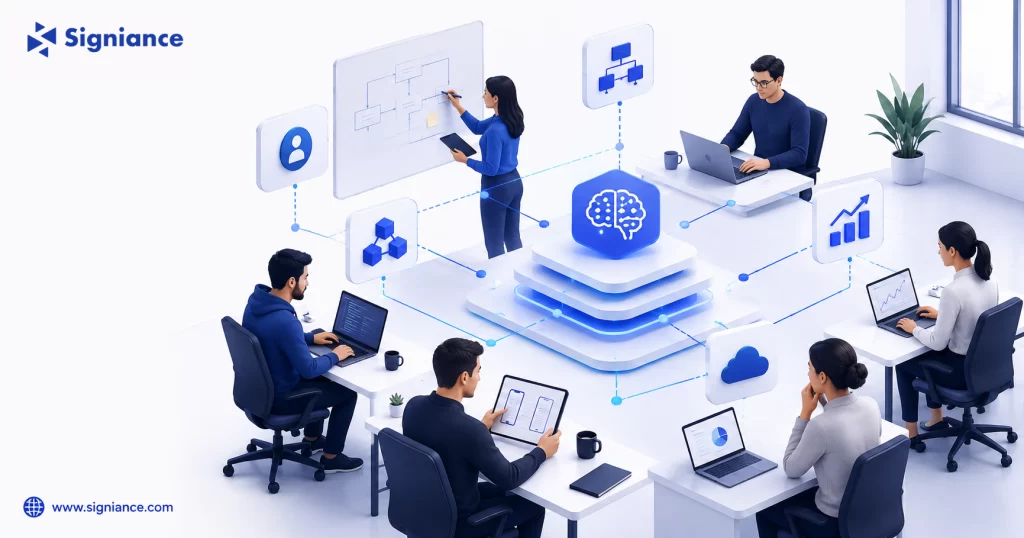
Build a practical AI product team using existing engineering skills, clear ownership, and targeted specialist support.
Building an AI native product does not automatically mean hiring machine learning researchers, data scientists, and a large AI team. For most startups, the better approach is to structure a small product and engineering team around AI workflows, model integration, data, evaluation, infrastructure, and product outcomes. This guide explains which roles you actually need, what each person should own, and when to bring in specialist expertise.
Table of Contents
- Topic Introduction
- Why Team Structure Matters for AI Native Products
- How to Structure the Team
- When to Add AI Specialists
- 7 Ways to Structure Your AI Native Product Team
- Example Team Structure
- Related Resources
- Conclusion
Many startup founders assume that building an AI native product requires a dedicated research team. That can be true for companies developing new foundation models, advanced algorithms, or proprietary machine learning research. It is usually not necessary for a startup building an application around existing models, private data, AI workflows, retrieval, automation, or intelligent product features.
The real challenge is not having researchers. It is giving the existing team clear ownership of the AI parts of the product. Without that structure, AI work becomes scattered across developers, product managers, cloud engineers, and external vendors, making it harder to control quality, cost, security, and reliability.
A well-structured team can:
- Ship AI Features: Move AI capabilities from experiments into production.
- Control Costs: Understand model and infrastructure spending.
- Improve Quality: Measure whether AI outputs meet product requirements.
- Protect Data: Define clear ownership for data access and security.
- Reduce Hiring: Use existing engineering skills before adding specialists.
Why Team Structure Matters for AI Native Products
- Different Engineering Needs: AI products require more than API integration because models, prompts, retrieval, data, evaluation, and infrastructure interact with each other.
- Clear Ownership Matters: AI features can fail when nobody owns model behavior, evaluation, data quality, or AI-related production issues.
- Hiring Can Get Expensive: Building a large AI team before product-market fit can increase fixed costs without solving the actual engineering problem.
- Existing Skills Transfer: Backend engineers, cloud engineers, product managers, and DevOps engineers can handle many AI product responsibilities with focused training and practical tooling.
- Specialists Have Specific Jobs: Researchers are valuable when the company has a genuine research problem. They should not be hired simply because the product contains AI.
How to Structure the Team
The most practical structure is based on responsibilities rather than job titles.
| Responsibility | Primary Owner | Typical Skills | When Needed |
|---|---|---|---|
| Product Requirements | Product Lead | Product management, user research | From day one |
| AI Application | Backend or AI Engineer | APIs, Python, workflows | From day one |
| Data | Backend/Data Engineer | Databases, pipelines, data quality | Early stage |
| Cloud Infrastructure | Cloud/DevOps Engineer | AWS, containers, monitoring | Early production |
| Evaluation | AI Engineer + Product | Testing, metrics, datasets | Before scale |
| Security | Engineering + Cloud | IAM, encryption, access control | Before customer data |
| Model Research | Specialist | ML research, model training | Only when required |
| UX | Product Designer | UX, workflows, interfaces | From day one |
This structure allows one person to own multiple areas during the early stages.
When to Add AI Specialists
Do not hire based only on the fact that the product uses AI. Hire when the technical problem requires specialist knowledge.
| Situation | Team Response |
|---|---|
| Using managed LLM APIs | Existing engineers can usually handle integration |
| Building RAG workflows | AI/backend engineer can own retrieval and evaluation |
| Fine-tuning existing models | Add ML expertise when experimentation becomes substantial |
| Training proprietary models | Consider dedicated ML researchers and engineers |
| Developing new algorithms | Hire research expertise |
| High-volume AI workloads | Strengthen infrastructure and cost engineering |
| Complex AI evaluation | Add dedicated evaluation ownership |
| Regulated enterprise workloads | Strengthen security and governance expertise |
A startup should first identify the constraint, then hire for that constraint.
7 Ways to Structure Your AI Native Product Team
1. Make Product Ownership the Starting Point
AI development should begin with a product problem rather than a model.
- Define User Value: Identify the specific user action the AI feature improves.
- Set Success Metrics: Define measurable outcomes before selecting models.
- Prioritize Workflows: Focus the team on complete workflows rather than isolated AI capabilities.
- Control Scope: Avoid building AI features simply because a model can perform the task.
- Own Tradeoffs: Product leadership should decide where quality, speed, and cost need to be balanced.
The product owner does not need to be an AI expert. They need to understand what the AI feature is supposed to achieve.
2. Turn Backend Engineers Into AI Application Engineers
A strong backend engineer can often handle much of the application layer of an AI product.
- Build Model Services: Create controlled interfaces between the application and model providers.
- Manage Workflows: Connect models with APIs, databases, tools, and business logic.
- Handle Failures: Implement retries, fallbacks, timeouts, and error handling.
- Manage State: Store conversations, workflow state, user context, and application data properly.
- Track Requests: Capture model usage, latency, errors, and cost.
This is different from training models. The focus is building reliable software around models.
3. Give Data Engineering Clear Ownership
AI output depends heavily on the information supplied to the system.
- Define Data Sources: Document where AI workflows obtain information.
- Maintain Data Quality: Monitor missing, outdated, duplicated, or incorrect information.
- Control Access: Restrict AI workflows to approved data sources.
- Build Pipelines: Automate ingestion, transformation, indexing, and updates.
- Track Changes: Know when important source data changes.
A data engineer does not need to become a machine learning researcher to support most AI application workloads.
4. Make DevOps Part of AI Development
AI workloads introduce infrastructure requirements that traditional applications may not have.
- Monitor Model Calls: Track latency, errors, throughput, and usage.
- Control Infrastructure: Monitor compute, storage, networking, and supporting services.
- Manage Deployments: Keep model, prompt, application, and infrastructure changes controlled.
- Set Cost Alerts: Detect unusual increases in model or cloud spending.
- Build Recovery: Prepare fallback paths for unavailable providers or failed services.
For startups already using AWS, existing DevOps skills can cover much of this responsibility.
5. Create Shared AI Evaluation Ownership
You do not necessarily need a dedicated evaluation engineer at the beginning.
- Define Quality Rules: Establish what good AI output means for each important workflow.
- Build Test Sets: Create representative examples from actual product use cases.
- Compare Versions: Test prompts, models, retrieval changes, and application changes.
- Track Failures: Record hallucinations, irrelevant answers, missing information, and incorrect actions.
- Review Production Data: Use real failure patterns to improve test coverage.
Evaluation can initially be shared between product, engineering, and domain experts.
6. Use Specialists Only for Specialist Problems
External experts or dedicated hires become valuable when the problem goes beyond normal AI application engineering.
- Research Problems: Hire researchers when developing new algorithms or model techniques.
- Model Training: Add ML specialists when training or substantially fine-tuning models becomes core to the product.
- Advanced Optimization: Bring in expertise when model performance requires specialized optimization.
- Complex Data Science: Add data science skills when prediction and statistical modeling become central.
- Temporary Expertise: Use external specialists when the requirement is important but not permanent.
The key is to match expertise to the technical problem.
7. Create Clear Ownership Before Adding Headcount
Many AI teams struggle because responsibilities overlap.
- Assign One Owner: Every important AI system should have a clearly accountable owner.
- Define Interfaces: Document how product, engineering, data, and infrastructure responsibilities connect.
- Separate Decisions: Decide who owns model selection, prompts, data, evaluation, security, and cost.
- Document Operations: Record how the system is deployed, monitored, tested, and recovered.
- Review Ownership: Update responsibilities as the product and team grow.
A small team with clear ownership can outperform a larger team with unclear responsibilities.
Example Team Structure
A startup with 6 to 8 technical and product people could structure responsibilities like this:
| Person | Primary Role | AI Responsibilities |
|---|---|---|
| Founder/Product Lead | Product | AI use cases, priorities, success metrics |
| Backend Engineer | AI Application | Model APIs, workflows, tools |
| Backend Engineer | Platform | Application services, databases, APIs |
| Data Engineer | Data | Pipelines, retrieval data, quality |
| DevOps Engineer | Infrastructure | AWS, deployments, monitoring, cost |
| Product Designer | UX | AI interaction and user workflows |
| QA/Engineer | Evaluation | Test sets, regression checks, failure tracking |
| Specialist | As Needed | Research, fine-tuning, optimization |
One person can hold multiple responsibilities at an early stage.
For example, the backend engineer can own AI application development while the DevOps engineer manages AI infrastructure and cost controls. Product can own evaluation criteria while engineering implements the evaluation system.
What You Should Not Hire Too Early
Avoid adding expensive specialist roles before the product requires them.
| Hiring Too Early | Better First Step |
|---|---|
| ML Researcher | Use managed foundation models |
| Large Data Science Team | Start with focused data engineering |
| Dedicated Prompt Engineer | Make prompt ownership part of AI engineering |
| Large MLOps Team | Extend existing DevOps practices |
| AI Research Department | Validate the product use case first |
| Multiple AI Architects | Assign architecture ownership to senior engineering |
The exception is when the company’s competitive advantage genuinely depends on proprietary model research.
A Practical Hiring Sequence
For most AI application startups, a reasonable progression is:
Stage 1: MVP
- Start Lean: Product lead plus existing software engineers.
- Use Managed Models: Avoid unnecessary model infrastructure.
- Measure Early: Track cost, latency, and output quality.
Stage 2: Production
- Add Infrastructure: Strengthen AWS, DevOps, monitoring, and security.
- Formalize Data: Establish reliable data pipelines and access controls.
- Add Evaluation: Create repeatable tests for important AI workflows.
Stage 3: Scale
- Specialize Roles: Split AI application, data, infrastructure, and evaluation ownership.
- Optimize Costs: Introduce model routing, caching, and workflow optimization.
- Add Specialists: Hire ML experts only where the product has a genuine technical requirement.
Conclusion
You do not need a research team to build a strong AI native product. You need clear ownership across product, AI application engineering, data, infrastructure, evaluation, and security, with specialist expertise added only when the technical problem demands it. If you are planning an AI native architecture on AWS, talk to Signiance Technologies, designing the right team and technical structure for your product.