
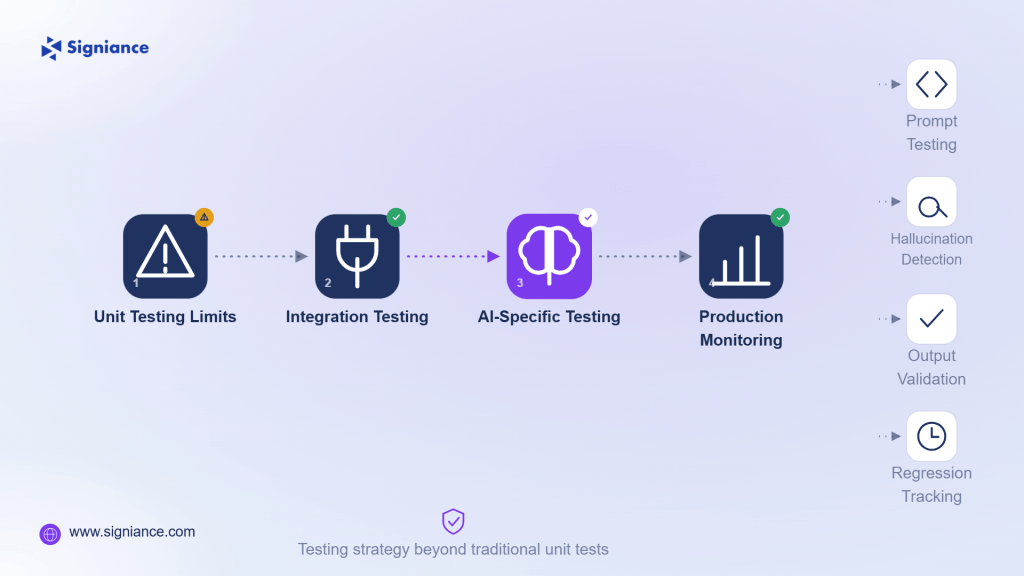
Beyond Unit Tests
Build reliable AI products by testing models, prompts, data, workflows, and production behavior together
Traditional unit tests are important, but they cannot fully validate an AI-native product. AI systems can produce different outputs for similar inputs, fail on unexpected data, behave differently after model or prompt changes, and introduce risks that standard application tests may miss. This guide explains how to build a practical testing strategy that covers the full AI product lifecycle.
Table of Contents
- Introduction
- Why It Matters
- How to Test
- When to Test
- Testing Framewor
- Conclusion
Topic Introduction
AI-native products behave differently from traditional software. A normal application may return the same result when given the same input, while an AI system can generate different outputs, depend on model versions, respond differently to prompts, or fail because the input falls outside the examples used during development.
This creates a testing gap. A product can pass its unit tests while still producing incorrect answers, exposing sensitive information, calling the wrong tool, or failing when a model provider changes its behavior.
A strong testing strategy for AI-native products therefore needs multiple layers. Unit tests remain part of the process, but they should be combined with evaluation datasets, prompt tests, integration tests, safety tests, regression tests, and production monitoring.
Why AI Product Testing Matters
- Different failure modes: AI systems can fail through incorrect outputs, hallucinations, poor reasoning, unsafe responses, or unexpected tool calls.
- Changing behavior: Model updates, prompt changes, retrieval changes, and configuration changes can alter application behavior without traditional code changes.
- User input variation: Real users rarely provide perfectly structured inputs, so systems need testing against ambiguous, incomplete, and adversarial requests.
- Business risk: Incorrect AI outputs can affect customer support, financial decisions, internal workflows, or other business processes.
- Production feedback: Some AI failures only become visible when the system encounters real-world inputs that were not represented in development tests.
How to Build an AI Testing Strategy
An effective strategy uses multiple testing layers rather than relying on one test type.
| Testing Layer | What to Test | Example |
|---|---|---|
| Unit testing | Application logic | Input validation and utility functions |
| Prompt testing | Prompt behavior | Required instructions and output structure |
| Model evaluation | Output quality | Accuracy, relevance, completeness |
| Retrieval testing | Retrieved context | Correct documents and ranking |
| Integration testing | End-to-end workflow | Application to model to database |
| Safety testing | Harmful or unsafe behavior | Prompt injection and sensitive data exposure |
| Regression testing | Changes over time | New model versus previous baseline |
| Load testing | System performance | Concurrent AI requests |
| Production monitoring | Real user behavior | Error rates and quality signals |
The goal is not to test every possible AI output manually. The goal is to establish measurable expectations and automate as much validation as possible.
When to Run Different AI Tests
| Development Stage | Tests to Prioritize | Main Objective |
|---|---|---|
| Feature design | Evaluation criteria | Define what good output means |
| Development | Unit and prompt tests | Catch basic implementation errors |
| Integration | Workflow and retrieval tests | Validate system interactions |
| Pre-release | Regression and safety tests | Detect quality and security problems |
| Load testing | Performance tests | Validate capacity and latency |
| Production | Monitoring and sampling | Detect issues in real usage |
| Model update | Full regression evaluation | Compare old and new behavior |
| Prompt update | Prompt and evaluation tests | Confirm intended behavior remains stable |
Testing should happen before deployment, but it should not stop after deployment. AI systems depend on models, data, prompts, external services, and user behavior that can change over time.
Top 8 Ways to Test AI-Native Products
1. Keep Unit Tests for Deterministic Logic
Unit tests remain essential for the parts of the product that should behave predictably.
- Test application logic: Validate deterministic functions independently from the model.
- Test validation rules: Check required fields, input formats, and business constraints.
- Test error handling: Confirm expected behavior when services fail.
- Test permissions: Verify that users can access only authorized functions and data.
- Test transformations: Validate data formatting before it reaches the model.
- Separate concerns: Keep model behavior tests separate from ordinary application unit tests.
Unit tests should not be removed because the application contains AI. They simply should not be treated as the complete testing strategy.
2. Build a Representative Evaluation Dataset
AI quality needs examples that reflect the actual work users expect the system to perform.
- Use real scenarios: Build test cases from realistic application workflows.
- Include edge cases: Add incomplete, ambiguous, and unusual inputs.
- Cover user intents: Represent the important ways users interact with the product.
- Define expected behavior: Establish what constitutes an acceptable response.
- Version datasets: Track changes to evaluation cases over time.
- Protect sensitive data: Remove unnecessary personal or confidential information from test datasets.
A useful evaluation dataset becomes a repeatable benchmark for comparing prompts, models, retrieval systems, and application changes.
3. Test Prompts as Application Logic
Prompts can directly affect application behavior, so changing them should be treated as a meaningful software change.
- Test instructions: Confirm that required rules are consistently followed.
- Test output format: Verify structured outputs, fields, and required content.
- Test conflicting inputs: Check whether user instructions can override system requirements.
- Test long inputs: Evaluate behavior when context becomes large.
- Test ambiguous prompts: Confirm the system handles unclear requests appropriately.
- Track versions: Keep prompt changes under version control.
Prompt tests are particularly important when prompts contain business rules, tool instructions, or restrictions on what the model can do.
4. Evaluate Model Output Quality
A response can be technically valid while still being poor for the intended use case.
- Measure relevance: Check whether the response addresses the user’s request.
- Measure accuracy: Compare outputs against trusted information where possible.
- Check completeness: Identify important information that the model consistently misses.
- Measure consistency: Look for unacceptable variation across similar requests.
- Use human review: Have domain experts assess difficult or high-impact outputs.
- Automate scoring: Use repeatable evaluation methods for large test sets.
For many AI products, quality cannot be represented by a single accuracy number. Different use cases require different evaluation criteria.
5. Test Retrieval and Context
Retrieval-augmented applications introduce another failure point. The model may generate a reasonable answer from the wrong documents.
- Test retrieval accuracy: Check whether relevant documents are returned.
- Test ranking: Verify that the most useful context appears prominently.
- Test missing data: Confirm appropriate behavior when relevant information is unavailable.
- Test stale content: Identify responses based on outdated documents.
- Test source handling: Verify that the system uses retrieved information correctly.
- Test access controls: Ensure users cannot retrieve documents they are not authorized to access.
For RAG systems, testing only the final response can hide retrieval problems.
6. Test AI Security and Abuse Cases
AI applications need security testing that accounts for model-specific attack patterns.
- Test prompt injection: Check whether untrusted instructions can alter system behavior.
- Test data leakage: Verify that sensitive information is not exposed through responses.
- Test tool access: Confirm that the model cannot invoke unauthorized actions.
- Test malicious input: Evaluate behavior against intentionally harmful requests.
- Test boundary controls: Verify restrictions around sensitive operations.
- Test output handling: Prevent model-generated content from becoming an unchecked command or query.
The OWASP Top 10 for Large Language Model Applications provides a useful reference for identifying common security risks in LLM-based applications. (OWASP)
7. Run Regression Tests After Every Significant Change
AI systems can regress even when a change appears unrelated.
- Compare baselines: Keep previous evaluation results for comparison.
- Test model changes: Re-run evaluations when changing model versions.
- Test prompt changes: Validate behavior after modifying system instructions.
- Test retrieval changes: Recheck quality after changing embeddings or retrieval logic.
- Test dependencies: Repeat important tests after changing external AI services.
- Block regressions: Prevent releases when critical evaluation scores fall below agreed thresholds.
Regression testing turns AI evaluation into an ongoing engineering process rather than a one-time quality check.
8. Monitor the Product After Deployment
Pre-production testing cannot reproduce every real-world interaction.
- Track failures: Monitor application and model-related errors.
- Sample outputs: Review representative responses for quality issues.
- Track latency: Measure response times across important workflows.
- Monitor cost: Identify unexpected increases in model usage.
- Track user feedback: Use negative feedback to identify missing evaluation cases.
- Update tests: Convert important production failures into repeatable regression tests.
Production monitoring should feed back into the test suite. A failure discovered in production can become a permanent test case that helps prevent the same issue from returning.
A Practical AI Testing Pyramid
A useful testing structure starts with inexpensive deterministic tests and moves toward broader evaluations.
| Layer | Test Frequency | Relative Cost | Purpose |
|---|---|---|---|
| Unit tests | Every code change | Low | Validate application logic |
| Prompt tests | Every prompt change | Low | Validate instructions |
| Integration tests | Every major change | Medium | Validate system workflows |
| Evaluation tests | CI or release pipeline | Medium | Measure AI quality |
| Security tests | Regularly and before release | Medium | Identify AI-specific risks |
| Load tests | Before major releases | High | Validate performance |
| Human evaluation | Major releases and samples | High | Assess difficult quality questions |
| Production monitoring | Continuously | Variable | Detect real-world problems |
The exact mix depends on the product. A customer support assistant and an AI system that executes infrastructure actions should not have identical testing requirements.
Conclusion
Testing an AI-native product requires more than checking whether the code works. Unit tests should cover deterministic logic, while evaluation tests, prompt tests, retrieval tests, security tests, regression tests, and production monitoring validate the parts of the system that can change or behave unpredictably.
If your team is building an AI product on AWS, Signiance Technologies can help design the testing, deployment, monitoring, and DevOps practices needed to operate it reliably.