
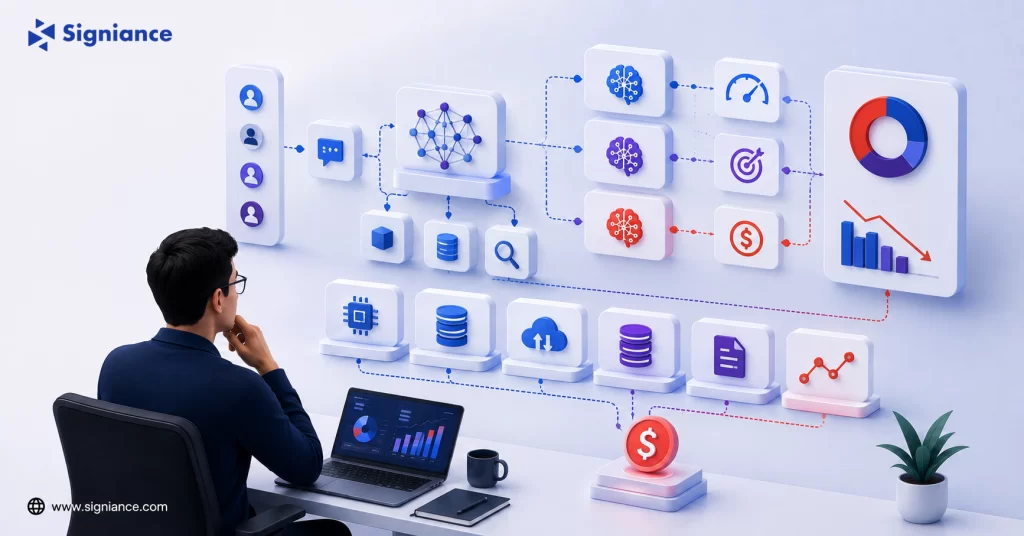
Build an AI cost model early so your product can grow without letting inference, infrastructure, and usage costs outpace revenue.
AI features can look inexpensive during development and become costly after users start using them at scale. Every request can trigger model inference, retrieval, databases, compute, storage, logging, and network activity. This guide explains how to design a cost architecture before scaling, so you can estimate the cost of each AI feature, identify expensive components, and make better infrastructure decisions before they become difficult to change.
Table of Contents
- Topic Introduction
- Why AI Cost Architecture Matters
- How to Design an AI Cost Architecture
- When to Review AI Costs
- 8 Steps to Design Your AI Cost Architecture
- Practical AI Cost Architecture Example
- Metrics to Track Before Scaling
- Conclusion
The biggest mistake founders make with AI costs is looking only at the price of the model. A single user action may trigger several model calls, document retrieval, database queries, background processing, storage, logging, and network traffic. When usage increases, these supporting costs can grow along with model usage.
The goal of a cost architecture is to understand the complete cost of serving one AI interaction and one customer. By designing this before scale, your team can choose suitable models, control unnecessary processing, set usage limits, and understand whether the AI feature can support healthy unit economics.
Why AI Cost Architecture Matters
- Protects Unit Economics: AI costs can increase with every customer interaction, so uncontrolled usage can reduce the margin generated by each customer.
- Improves Cost Forecasting: Measuring cost per request gives founders a practical way to estimate monthly infrastructure spending at different usage levels.
- Prevents Architecture Rework: Cost controls are easier to add before thousands of customers depend on the system.
- Supports Model Selection: Understanding the complete workflow helps teams decide whether a cheaper model is sufficient for a particular task.
- Controls Scaling Risk: Usage limits, monitoring, caching, and routing can prevent unexpected increases in infrastructure spending.
How to Design an AI Cost Architecture
The first step is to map every component involved in an AI request.
| Cost Component | What to Measure | Cost Control |
|---|---|---|
| Model Inference | Input and output usage | Select suitable models |
| Model Calls | Calls per user action | Remove unnecessary calls |
| Retrieval | Searches and retrieved content | Limit retrieved context |
| Embeddings | Documents processed | Process only required data |
| Compute | CPU, memory, GPU usage | Match capacity to workload |
| Database | Queries and storage | Optimize queries |
| Network | Data transferred | Reduce unnecessary movement |
| Logging | Logs and retention | Set retention policies |
| Storage | Files, vectors, and records | Remove unused data |
| Caching | Repeated requests | Reuse stable results |
| Monitoring | Metrics and traces | Monitor critical paths |
| Background Jobs | Async processing | Schedule efficiently |
A Basic Cost Formula
A useful starting point is:
Monthly AI Cost = Number of Users × Requests Per User × Cost Per Request
For a more detailed estimate:
Cost Per Request = Model Cost + Retrieval Cost + Compute Cost + Storage Cost + Network Cost + Monitoring Cost
This does not replace your actual cloud billing calculation. It gives the engineering and business teams a common framework for understanding where costs originate.
When to Review AI Costs
Cost planning should happen throughout the product lifecycle rather than after receiving the first large infrastructure bill.
| Stage | Cost Activity | Key Question |
|---|---|---|
| Idea | Estimate usage | What could one customer cost? |
| Prototype | Measure model usage | What does one request consume? |
| MVP | Compare architectures | Which components drive cost? |
| Beta | Study real usage | How are customers actually using the feature? |
| Production | Monitor costs | Are actual costs matching estimates? |
| Growth | Optimize workflows | Which components need improvement? |
| Scale | Review unit economics | Is revenue growing faster than cost? |
8 Steps to Design Your AI Cost Architecture Before You Scale
1. Define the Unit of Cost
You cannot manage AI costs until you know what you are measuring.
- Choose One Unit: Use a request, conversation, document, task, or workflow as the primary cost unit.
- Map User Actions: Identify which customer actions trigger AI processing.
- Count Workflow Steps: Document every service and model called by one action.
- Separate Workloads: Treat chat, extraction, classification, search, and background processing independently.
- Calculate Baseline: Estimate the cost of one normal customer interaction.
For example, a support request may trigger classification, retrieval, generation, validation, and database operations. The actual cost is therefore higher than the price of the final model response.
2. Map Every Model Call
One visible AI interaction can contain multiple model calls.
- List All Calls: Document every model request inside the workflow.
- Find Hidden Calls: Check whether classification, routing, summarization, or validation uses another model.
- Measure Frequency: Calculate how many times each model is called during one workflow.
- Remove Duplication: Identify calls that repeat information already available.
- Set Call Limits: Prevent unexpected loops and repeated processing.
A workflow that makes four model calls per request can become expensive even when each individual call appears inexpensive.
3. Measure Input and Output Usage
The size of the information sent to and returned by a model directly affects many AI workloads.
- Measure Input Size: Record the typical amount of information sent to the model.
- Track Output Size: Measure average and maximum response lengths.
- Remove Unused Context: Do not send information the model does not need.
- Limit Output: Set practical output limits where long responses provide little value.
- Monitor History: Watch whether conversation history causes request size to increase over time.
Large prompts, long documents, and unnecessary conversation history can increase costs without improving the result proportionally.
4. Choose Models by Workload
Using one model for every task is rarely the most cost-effective architecture.
- Classify Tasks: Separate simple tasks from tasks requiring deeper reasoning.
- Test Smaller Models: Check whether lower-cost models meet the required quality level.
- Reserve Stronger Models: Use more capable models when the task justifies their additional cost.
- Compare Total Cost: Include the number of calls and tokens, not just model pricing.
- Retest Regularly: Review model choices as workloads and available models change.
A model should be selected because it meets the requirements of the task at an acceptable cost.
5. Control Retrieval and Context
Retrieval can improve an AI application’s access to private or current information, but it also adds processing and model input costs.
- Retrieve Relevant Data: Return only information related to the current request.
- Limit Retrieved Content: Avoid passing large amounts of irrelevant text to the model.
- Filter Early: Remove unnecessary content before model inference.
- Cache Repeated Searches: Reuse results when the underlying information has not changed.
- Measure Retrieval Cost: Include search and data-processing costs in the request estimate.
The objective is not to retrieve the maximum amount of information. It is to retrieve enough useful information to complete the task.
6. Use Caching Where Appropriate
Repeated processing is one of the easiest areas to examine for cost reduction.
- Cache Stable Results: Store responses that can safely be reused.
- Cache Common Data: Reuse frequently requested information where freshness allows it.
- Set Expiration: Define when cached information must be refreshed.
- Protect Accuracy: Avoid caching results where information changes frequently or user context matters.
- Measure Cache Hits: Track how many requests avoid new model processing.
Caching can reduce duplicate model calls, retrieval operations, and database queries.
7. Calculate Cost Per Customer
Total monthly cloud spending does not tell you whether the AI feature has sustainable unit economics.
- Measure Customer Usage: Calculate average requests per active customer.
- Segment Customers: Compare low, medium, and high usage accounts.
- Find Outliers: Identify customers generating unusually high AI consumption.
- Compare Revenue: Measure estimated AI and infrastructure cost against customer revenue.
- Track Trends: Watch whether customer cost increases as product usage grows.
For example, if an average customer generates $8 in monthly AI and infrastructure costs but produces $100 in monthly revenue, the economics may be reasonable. If usage pushes the cost to $70, the architecture deserves closer review.
8. Set Cost Controls Before Production
Cost controls should exist before the system receives significant traffic.
- Set Request Limits: Prevent individual users from generating excessive requests.
- Set Input Limits: Restrict unusually large prompts and document uploads.
- Set Budget Alerts: Create alerts when spending crosses expected thresholds.
- Add Rate Limits: Protect services from sudden traffic increases and repeated requests.
- Define Escalation: Decide what the system should do when usage exceeds expected limits.
These controls reduce the risk of an unexpected usage spike becoming an unexpected cloud bill.
Practical AI Cost Architecture Example
A simple architecture can separate the major cost areas:
| Layer | Responsibility | Cost Control |
|---|---|---|
| Application | Receives user request | Rate limits |
| API Layer | Routes requests | Request tracking |
| Orchestration | Controls workflow | Reduce unnecessary calls |
| Model Layer | Generates output | Model selection |
| Retrieval | Finds relevant information | Context limits |
| Cache | Stores reusable results | Reduce duplicate work |
| Database | Stores application data | Query optimization |
| Compute | Runs application services | Capacity management |
| Monitoring | Tracks performance | Log retention |
| Billing Metrics | Measures usage | Cost alerts |
This separation gives your team a clear view of where money is being spent.
If model inference represents 60% of the cost, model selection and request optimization may have the biggest impact. If database and retrieval costs represent 40%, changing the model alone may not solve the problem.
A Simple Cost Projection
Suppose your AI feature has:
| Variable | Example |
|---|---|
| Monthly Active Users | 10,000 |
| Requests Per User | 30 |
| Monthly Requests | 300,000 |
| Average Cost Per Request | $0.015 |
| Estimated Monthly AI Processing | $4,500 |
If usage doubles to 20,000 users while the request pattern remains the same:
| Variable | Example |
|---|---|
| Monthly Active Users | 20,000 |
| Requests Per User | 30 |
| Monthly Requests | 600,000 |
| Average Cost Per Request | $0.015 |
| Estimated Monthly AI Processing | $9,000 |
The important question is not simply whether $9,000 is affordable.
The real question is:
How does the additional $4,500 in cost compare with the revenue generated by those additional customers?
That is why cost architecture needs to connect technical usage with business metrics.
Metrics to Track Before Scaling
| Metric | Why It Matters |
|---|---|
| Cost Per Request | Shows the direct cost of an AI interaction |
| Requests Per User | Helps forecast usage growth |
| Model Calls Per Request | Identifies unnecessary processing |
| Input Usage | Reveals large prompts and context costs |
| Output Usage | Shows generation costs |
| Retrieval Calls | Measures retrieval-related workload |
| Cache Hit Rate | Shows how much repeated work is avoided |
| Cost Per Customer | Connects infrastructure to unit economics |
| Revenue Per Customer | Helps determine whether AI costs are sustainable |
| Cost Growth Rate | Shows whether costs are growing faster than revenue |
Conclusion
AI cost architecture should be designed before usage becomes difficult to control. Measure the full cost of each AI workflow, select models according to workload, control context and repeated processing, and connect infrastructure spending to customer revenue. If you are preparing an AI application for production on AWS, Signiance Technologies can help design the architecture, cost controls, monitoring, and deployment strategy.